
I’ll never forget the moment I realized my email marketing platform was costing me more than my morning coffee habit—and delivering about as much value. There I was, staring at a $120 monthly bill for features I didn’t use, while my subscriber list barely cracked 2,000 people. That painful realization sent me down a rabbit hole of platform comparisons that ultimately saved my business hundreds of dollars and dramatically improved my email performance. If you’re wrestling with the same frustration, wondering whether you should stick with the familiar name or explore alternatives, you’re in the right place.
Choosing the right email marketing platform in 2025 isn’t just about sending newsletters—it’s about building genuine connections with your audience while keeping your budget intact. With Email Marketing Platforms Compared: Mailchimp vs ConvertKit vs Substack vs Brevo, we’re diving deep into four of the most talked-about solutions to help you make an informed decision that aligns with your goals, technical comfort level, and wallet.
Key Takeaways
- Brevo offers the most generous free plan with 9,000 emails per month (300 daily) to 100,000 contacts, compared to Mailchimp’s 1,000 emails to 500 contacts
- Pricing models vary dramatically: Brevo charges by emails sent ($15-17/month starting), Mailchimp by subscribers ($45/month), ConvertKit starts at $39/month, and Substack takes 10% of paid subscriptions
- Automation capabilities differ significantly: Brevo provides advanced visual journey builders on lower tiers, while Mailchimp requires $90/month Standard plan for multistep workflows
- Substack dominates the newsletter market with 60% market share, positioning itself as the creator-first platform with built-in monetization
- Deliverability features give Brevo an edge with authentication wizards, IP warmup support, and advanced monitoring tools that outperform Mailchimp in 2025 testing[1]
Understanding the Email Marketing Platform Landscape in 2025
The email marketing world has evolved dramatically over the past few years. What used to be a straightforward choice between a handful of enterprise solutions has exploded into a diverse ecosystem serving everyone from solo bloggers to multinational corporations.
Email Marketing Platforms Compared: Mailchimp vs ConvertKit vs Substack vs Brevo represents four distinct philosophies about how email marketing should work:
- Mailchimp: The household name that grew from a scrappy startup to an Intuit-owned powerhouse
- ConvertKit (now Kit): The creator-focused platform that speaks the language of bloggers and course creators
- Substack: The newsletter-first platform that’s revolutionizing independent publishing
- Brevo (formerly Sendinblue): The European challenger offering multi-channel marketing at competitive prices
Each platform has carved out its niche, and understanding these differences is crucial to making the right choice for your specific needs.
The Market Share Reality
Here’s something that surprised me when I started researching: Substack absolutely dominates the newsletter software market with 60% market share, followed by Beehiiv with 20%[9]. Meanwhile, the traditional players like Mailchimp, ConvertKit, and Ghost each hold approximately 5% of the newsletter-specific market.
This doesn’t mean Mailchimp or Brevo are inferior—it simply reflects the different use cases these platforms serve. Substack has captured the independent creator and journalist market, while Mailchimp and Brevo continue to dominate in ecommerce and business marketing contexts.
Pricing Breakdown: Email Marketing Platforms Compared: Mailchimp vs ConvertKit vs Substack vs Brevo
Let’s talk money, because this is where the rubber meets the road. I’ve built a comprehensive comparison that reveals some eye-opening differences in how these platforms structure their pricing.
The Free Plan Face-Off
If you’re just starting out or testing the waters, free plans matter enormously. Here’s how they stack up:
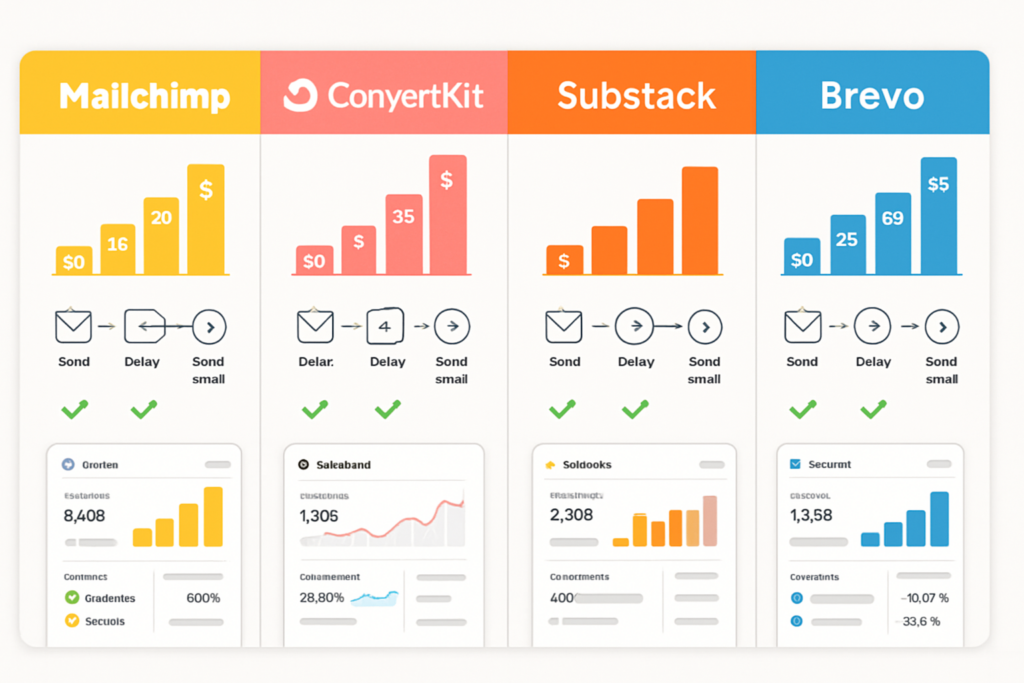
| Platform | Monthly Email Limit | Contact Limit | Key Restrictions |
|---|---|---|---|
| Brevo | 9,000 (300/day) | 100,000 | Brevo logo on emails |
| Mailchimp | 1,000 | 500 | Single audience, basic templates |
| ConvertKit | 0 | 1,000 | Landing pages only, no email sends |
| Substack | Unlimited | Unlimited | 10% fee on paid subscriptions |
Brevo’s free plan is staggeringly generous—offering 9,000 emails per month to up to 100,000 contacts[1][3]. When I first saw these numbers, I had to double-check them. That’s nine times more emails than Mailchimp’s free tier, and you can maintain a substantially larger contact list.
Mailchimp’s free plan, while respectable, caps you at 1,000 emails monthly to 500 contacts[1]. For a brand-new newsletter, this might suffice for a few months, but you’ll hit that ceiling quickly if you’re sending weekly updates.
ConvertKit’s “free” plan is really just a landing page builder—you can’t actually send emails without upgrading[5]. This makes it less useful for testing the platform before committing.
Substack’s approach is entirely different: unlimited emails to unlimited subscribers, but they take 10% of any paid subscription revenue you generate. If you’re planning to monetize through subscriptions, this fee structure becomes your primary cost consideration.
Paid Plan Pricing Structures
Once you outgrow free plans, the pricing models diverge significantly:
Brevo charges based on emails sent rather than subscriber count, starting at $15-17/month for email marketing features[1][3]. This model works beautifully if you have a large list but send infrequently. For example, if you have 5,000 subscribers but only send monthly newsletters, you’re paying for actual usage rather than list size.
Mailchimp uses subscriber-based pricing, with paid plans starting at $45/month[1]. As your list grows, so does your bill—regardless of how often you actually email your contacts. Their Standard plan, which unlocks multistep automation workflows, costs $90/month[1][2].
ConvertKit starts at $39/month for 1,000 subscribers[3][5], making it more expensive than both Brevo and Mailchimp’s entry-level paid plans for comparable subscriber counts. However, creators often justify this cost because of the platform’s creator-specific features and excellent customer support.
Substack remains free for sending, but continues taking 10% of paid subscriptions at all levels. There are no monthly fees, which simplifies budgeting—you only pay when you’re making money.
Hidden Costs and Token Systems
Here’s where things get sneaky. Mailchimp charges 25 Inbox Preview tokens monthly for email testing, and these tokens expire monthly[1]. If you exceed your allocation, you’ll need to purchase more. This nickel-and-diming frustrated me when I was using Mailchimp for client work—I’d burn through tokens testing campaigns, then face additional charges.
Brevo offers inbox preview testing at no additional charge[1], which might seem like a small thing but adds up over time, especially if you’re meticulous about testing emails across different clients and devices.
Feature Comparison: Automation and Workflows
Automation is where email marketing platforms truly differentiate themselves. The ability to set up sophisticated customer journeys, triggered sequences, and behavioral campaigns can transform your marketing from reactive to proactive.
Brevo’s Automation Advantage
Brevo offers more automation features than Mailchimp at lower price points, including a visual email journey builder with API and webhook triggers[1][2]. I was genuinely impressed when I first explored Brevo’s automation interface—it’s intuitive yet powerful, allowing you to create complex workflows without needing a computer science degree.
The visual builder lets you drag and drop triggers, conditions, and actions to create customer journeys that respond to subscriber behavior in real-time. You can set up automation based on:
- 📧 Email opens and clicks
- 🛒 Purchase behavior and abandoned carts
- 🌐 Website visits and page views
- 📅 Date-based triggers (birthdays, anniversaries, renewal dates)
- 🔗 API and webhook events from external systems
This last point—API and webhook triggers—is particularly powerful for businesses with custom applications or multiple marketing tools. You can trigger email sequences based on events happening in your CRM, ecommerce platform, or custom software.
Mailchimp’s Automation Limitations
Mailchimp certainly offers automation, but here’s the catch: you need their Standard plan ($90/month) to unlock multistep automation workflows[1][2]. The Essentials plan ($45/month) only provides basic automation like welcome emails and abandoned cart messages.
For small businesses and solopreneurs, this pricing structure can feel restrictive. You’re essentially paying double to access features that Brevo includes at lower tiers.
That said, Mailchimp’s automation interface is polished and user-friendly, with pre-built templates for common scenarios. If you’re willing to pay for the Standard plan, you’ll find robust capabilities including:
- Customer journey mapping
- Behavioral segmentation
- Predictive demographics
- Advanced scheduling options
ConvertKit’s Creator-Focused Sequences
ConvertKit approaches automation differently, focusing on what creators need most: email sequences and tag-based automation. Rather than complex visual builders, ConvertKit uses a simpler system of sequences (automated email series) and rules (if-this-then-that logic).
This simplicity is intentional. ConvertKit recognizes that most creators don’t need enterprise-level workflow builders—they need reliable ways to:
- Send welcome sequences to new subscribers
- Deliver lead magnets automatically
- Segment audiences based on interests
- Promote products to specific subscriber segments
The learning curve is gentler with ConvertKit, which matters if you’re a writer or creator who wants to focus on content rather than marketing technology. However, this simplicity comes with limitations—you won’t find the sophisticated multi-channel automation capabilities that Brevo offers.
Substack’s Minimalist Approach
Substack takes automation to its logical minimum: there essentially isn’t any. Substack is designed around the simple act of writing and publishing. When you hit publish, your post goes to all subscribers (or just paid subscribers, if you choose).
This might sound limiting, but it’s actually liberating for many creators. There’s no temptation to over-engineer your email marketing or get lost in complex automation workflows. You write, you publish, you connect with readers.
However, this simplicity means you can’t:
- Set up welcome sequences for new subscribers
- Create segmented campaigns for different audience groups
- Trigger emails based on subscriber behavior
- Build sophisticated nurture campaigns
For independent writers and journalists, this trade-off makes sense. For businesses running complex marketing campaigns, it’s a dealbreaker.
Multi-Channel Marketing Capabilities
In 2025, email rarely exists in isolation. The most effective marketing strategies integrate email with SMS, social media, chat, and other channels to create cohesive customer experiences.
Brevo’s Multi-Channel Dashboard
Brevo provides multi-channel capabilities including email, SMS, WhatsApp, and chat from a single dashboard[3]. This integration is genuinely impressive—you can manage conversations across channels, set up cross-channel automation, and view unified analytics showing how customers interact with your brand across touchpoints.
When I tested Brevo’s multi-channel features, I was struck by how seamlessly they work together. You can:
- 💬 Set up a workflow that sends an email, then follows up with SMS if the email isn’t opened
- 📱 Enable WhatsApp messaging for customer support while tracking conversations alongside email interactions
- 🤖 Deploy chatbots on your website that capture leads and add them to email sequences
- 📊 View unified reporting showing which channels drive the best engagement and conversions
This multi-channel approach is particularly valuable for ecommerce businesses and service providers who need to reach customers where they are, not just in their inboxes.
Mailchimp’s Growing Ecosystem
Mailchimp has expanded beyond email in recent years, adding landing pages, social media posting, postcards, and basic CRM functionality. However, SMS and WhatsApp require third-party integrations, which can feel clunky compared to Brevo’s native implementation.
The platform’s strength lies in its extensive integration marketplace—you can connect Mailchimp to virtually any tool in your marketing stack. But each integration adds complexity and potential points of failure.
ConvertKit’s Extension Requirements
ConvertKit requires third-party extensions for SMS and WhatsApp functionality[3]. The platform remains laser-focused on email marketing for creators, which means if you need multi-channel capabilities, you’ll be cobbling together solutions through Zapier or other integration tools.
For many creators, this isn’t a problem—email remains their primary channel, and they’re happy to use dedicated tools for other needs. But it does mean ConvertKit isn’t a true all-in-one marketing platform.
Substack’s Single-Channel Focus
Substack is email and web publishing, period. There’s no SMS, no chat, no WhatsApp. This singular focus is both a strength and a limitation, depending on your needs.
The platform does offer a mobile app where readers can discover and engage with publications, and writers can post short notes (similar to tweets). But fundamentally, Substack is about the newsletter format—long-form writing delivered to inboxes.
Deliverability: Getting Your Emails Into Inboxes
All the features in the world don’t matter if your emails land in spam folders. Deliverability—the ability to successfully reach subscriber inboxes—is the foundation of effective email marketing.
Brevo’s Deliverability Edge
In 2025 head-to-head testing, Brevo edged ahead of Mailchimp in deliverability features with an authentication wizard, IP warmup support, and advanced monitoring tools that Mailchimp lacks[1]. These technical advantages translate to real-world results.
Brevo’s shared IP infrastructure averages approximately 95% inbox placement according to their claims[4], with bounce-control safeguards to reduce spam complaints. The platform actively monitors sender reputation and provides guidance when issues arise.
The authentication wizard is particularly helpful for non-technical users. Setting up SPF, DKIM, and DMARC records—the authentication protocols that verify you’re a legitimate sender—can be intimidating. Brevo walks you through the process step-by-step, checking your configuration and confirming everything is set up correctly.
IP warmup support is crucial if you’re sending large volumes of email. When you first start using a new sending IP address, you need to gradually increase volume to establish a positive reputation with email providers. Brevo automates this process, protecting your deliverability during the critical early stages.
Mailchimp’s Deliverability Tools
Mailchimp certainly takes deliverability seriously, with dedicated IP addresses available on higher-tier plans and authentication setup guidance. However, the platform lacks some of the advanced monitoring and troubleshooting tools that Brevo provides.
One area where Mailchimp excels is its Inbox Preview feature, which shows how your email will appear across different email clients and devices. However, as mentioned earlier, this feature uses a token system that can incur additional costs[1].
ConvertKit’s Deliverability Reputation
ConvertKit maintains solid deliverability rates, though the platform provides fewer technical tools for monitoring and optimization compared to Brevo. The company focuses on maintaining clean sending practices and has strict policies against spam behavior.
For creators sending to engaged audiences, ConvertKit’s deliverability is generally excellent. The platform’s creator focus means most users are sending to opted-in subscribers who actively want their content—a recipe for good deliverability.
Substack’s Deliverability Approach
Substack handles deliverability behind the scenes, and generally does it well. The platform’s reputation benefits from its focus on quality content—Substack newsletters tend to have high engagement rates, which signals to email providers that the content is wanted.
However, you have limited visibility into deliverability metrics and no ability to troubleshoot issues yourself. You’re trusting Substack to handle this critical aspect of your newsletter’s success.
CRM and Contact Management Features
Modern email marketing platforms increasingly blur the line between email tools and customer relationship management (CRM) systems. The ability to track customer interactions, segment audiences, and maintain detailed contact records has become essential.
Brevo’s Built-In CRM
Brevo includes CRM functionality on its free plan, while Mailchimp requires paid tiers to access comparable CRM features[4]. This is a significant advantage for small businesses and solopreneurs who need basic contact management without paying for a separate CRM system.
Brevo’s CRM allows you to:
- 👤 Create detailed contact profiles with custom fields
- 📝 Log interactions and notes about individual contacts
- 🏷️ Organize contacts with tags and lists
- 📊 Track deals and sales pipeline stages
- 📅 Set tasks and reminders for follow-ups
While it’s not as sophisticated as dedicated CRM platforms like Salesforce or HubSpot, Brevo’s CRM is perfectly adequate for businesses with straightforward contact management needs.
Mailchimp’s Audience Management
Mailchimp’s audience management tools are robust, with advanced segmentation capabilities and detailed contact profiles. However, CRM features are locked behind paid plans, which can be frustrating if you’re trying to keep costs down while building your business.
The platform excels at creating complex segments based on behavior, demographics, and engagement patterns. You can build highly targeted campaigns that speak to specific audience subsets, which often leads to better engagement and conversion rates.
ConvertKit’s Tag-Based System
ConvertKit uses a tag-based system rather than traditional list management. This approach is more flexible in many ways—subscribers can have multiple tags indicating their interests, behaviors, and position in your marketing funnel.
For example, a subscriber might have tags like:
- “Interested in productivity”
- “Downloaded free ebook”
- “Attended webinar”
- “Purchased course”
You can then create segments and automation rules based on any combination of tags. This system feels more intuitive once you understand it, though it requires a mental shift if you’re coming from list-based platforms.
Substack’s Simple Subscriber Management
Substack keeps subscriber management intentionally simple. You can see who’s subscribed, who’s paid, and basic engagement metrics. There’s no tagging, no custom fields, no complex segmentation.
For independent publishers, this simplicity is often sufficient. You’re focused on creating great content for your entire audience, not running complex segmentation strategies.
AI-Powered Features and Content Creation
Artificial intelligence has rapidly become a differentiating factor among email marketing platforms. In 2025, AI assists with everything from subject line optimization to full email copy generation.
Brevo’s Aura AI
Brevo’s AI features (Aura AI) generate subject lines and copy that reportedly lift open rates by approximately 17%[1][4]. The AI functionality is more accessible than Mailchimp’s Intuit Assist, available at lower pricing tiers and easier to use for non-technical marketers.
I tested Aura AI extensively, and while I wouldn’t rely on it exclusively, it’s genuinely useful for:
- 🎯 Generating subject line variations when you’re stuck
- ✍️ Creating first drafts of promotional emails
- 🔄 Rewriting content in different tones or styles
- 💡 Suggesting content ideas based on your industry and audience
The AI understands context well, producing suggestions that feel relevant rather than generic. It’s particularly helpful when you’re facing writer’s block or need to produce multiple email variations quickly.
Mailchimp’s Intuit Assist
Mailchimp’s AI capabilities, branded as Intuit Assist, are powerful but less accessible than Brevo’s offering[1]. The features are primarily available on higher-tier plans, and the interface can feel overwhelming with its many options and settings.
That said, Intuit Assist offers sophisticated capabilities including:
- Predictive demographics (estimating subscriber age, gender, location)
- Send time optimization (determining the best time to email each subscriber)
- Content recommendations based on engagement patterns
- Creative Assistant for generating email designs
ConvertKit’s Limited AI
ConvertKit has been slower to adopt AI features, maintaining its focus on simplicity and creator control. As of 2025, the platform offers basic AI assistance for subject lines but doesn’t provide the comprehensive AI tools found in Brevo or Mailchimp.
For many creators, this is fine—they want to maintain their authentic voice and aren’t looking for AI to write their newsletters. However, it does mean ConvertKit users miss out on efficiency gains that AI can provide.
Substack’s AI Approach
Substack has taken a cautious approach to AI, reflecting the platform’s emphasis on authentic creator voices. There are no AI writing assistants or subject line generators built into the platform.
This aligns with Substack’s philosophy: the platform is about showcasing your unique perspective and writing style, not optimizing every element for maximum engagement through AI.
Use Cases: Who Should Choose Which Platform?
After comparing Email Marketing Platforms: Mailchimp vs ConvertKit vs Substack vs Brevo across multiple dimensions, clear patterns emerge about which platform suits different user types.
Choose Brevo If You:
- 🎯 Need multi-channel marketing (email, SMS, WhatsApp, chat) from one platform
- 💰 Want generous free plan limits or pay-per-send pricing
- 🤖 Value advanced automation without enterprise-level costs
- 📊 Need built-in CRM functionality
- 🚀 Require strong deliverability tools and monitoring
- 🏢 Run an ecommerce business or service company
Brevo is the best value proposition for small-to-medium businesses that need sophisticated features without breaking the bank. It’s particularly strong for companies that are growing and need a platform that can scale with them.
Choose Mailchimp If You:
- 🏆 Want the most recognized brand name in email marketing
- 🔌 Need extensive integrations with other marketing tools
- 🎨 Value highly polished templates and design tools
- 📈 Already use other Intuit products (QuickBooks, etc.)
- 👥 Have a larger team that needs collaboration features
- 🛍️ Run an established ecommerce business with significant revenue
Mailchimp remains the safe, established choice with the most extensive ecosystem. Despite higher costs, many businesses stick with Mailchimp because it “just works” and integrates seamlessly with their existing tools.
Choose ConvertKit (Kit) If You:
- ✍️ You’re a creator, blogger, or course creator
- 📚 You prioritize simplicity over feature complexity
- 🎓 You want excellent educational resources and support
- 💝 You need reliable lead magnet delivery
- 🏷️ You prefer tag-based subscriber management
- 🎤 You value a platform built specifically for your use case
ConvertKit is the creator’s choice, designed by creators for creators. If you’re building an audience around your content, courses, or creative work, ConvertKit speaks your language and provides exactly what you need without unnecessary complexity.
Choose Substack If You:
- 📰 You’re an independent writer or journalist
- 💵 You want built-in subscription monetization
- 📱 You value the Substack reader network and discovery features
- 🎯 You want to focus purely on writing, not marketing technology
- 🚫 You don’t need automation, segmentation, or complex campaigns
- 📖 You’re building a publication, not a marketing funnel
Substack dominates the newsletter market with 60% market share[9] for good reason—it removes all barriers between writers and readers. If your goal is to build a sustainable independent publication, Substack’s combination of simplicity and built-in monetization is unmatched.
Integration and Technical Considerations
The best email marketing platform doesn’t exist in isolation—it needs to connect with your website, ecommerce platform, CRM, and other marketing tools.
API and Developer Resources
Brevo and Mailchimp both offer robust APIs and extensive developer documentation, making them suitable for businesses with custom integration needs. You can build sophisticated workflows that connect your email marketing to proprietary systems and databases.
ConvertKit provides a solid API, though the documentation is less extensive than Mailchimp’s. For most creator use cases, the available integrations through Zapier and native connections suffice.
Substack offers limited API access, reflecting its focus on simplicity. You can embed signup forms on external websites, but deep technical integrations aren’t really the platform’s strength.
WordPress and Website Integration
All four platforms offer WordPress plugins and embed codes for signup forms. However, the implementation quality varies:
- Mailchimp has the most polished WordPress integration with multiple official plugins
- Brevo offers good WordPress support with form builders and automation triggers
- ConvertKit provides creator-friendly landing pages and forms that embed easily
- Substack offers simple embed codes, though customization options are limited
Ecommerce Platform Connections
For online stores, integration with ecommerce platforms is crucial:
Brevo and Mailchimp both integrate well with Shopify, WooCommerce, BigCommerce, and other major platforms. You can trigger abandoned cart emails, send post-purchase sequences, and segment customers based on purchase history.
ConvertKit offers ecommerce integrations but they’re less sophisticated, reflecting the platform’s creator focus rather than ecommerce specialization.
Substack isn’t designed for ecommerce integration—it’s about content subscriptions, not product sales.
Migration and Switching Considerations
If you’re considering switching from one platform to another, understanding the migration process is essential.
Exporting Your Data
All four platforms allow you to export your subscriber lists, typically as CSV files. However, the completeness of exported data varies:
- Mailchimp exports comprehensive subscriber data including custom fields, tags, and engagement history
- Brevo provides detailed exports with CRM data and interaction history
- ConvertKit exports subscriber information and tags cleanly
- Substack allows subscriber list exports, though engagement data is limited
Importing to New Platforms
Most platforms make importing straightforward, though you’ll need to:
- Clean your list to remove invalid addresses
- Map fields from your old platform to the new one
- Re-create segments, tags, or lists in the new system
- Rebuild automation workflows from scratch
- Update signup forms on your website
The most time-consuming aspect is typically rebuilding automation workflows, as these rarely transfer between platforms. Budget several hours to several days for this process, depending on complexity.
Maintaining Deliverability During Migration
When switching platforms, your sender reputation starts fresh. To maintain good deliverability:
- ✅ Authenticate your domain properly on the new platform
- 📧 Start with your most engaged subscribers
- 📈 Gradually increase sending volume over 2-4 weeks
- 👀 Monitor bounce rates and spam complaints closely
- 🚫 Re-engage or remove inactive subscribers before migrating
Real-World Performance Stories
Let me share some real experiences from businesses and creators who’ve navigated the Email Marketing Platforms Compared: Mailchimp vs ConvertKit vs Substack vs Brevo decision.
The Ecommerce Store That Saved $1,200 Annually
A friend runs a boutique skincare ecommerce business with about 8,000 subscribers. She was paying Mailchimp approximately $150/month because of her list size, despite only sending 2-3 emails weekly.
After switching to Brevo’s pay-per-send model, her costs dropped to $45-60/month—a savings of over $1,200 annually. She gained better automation tools in the process and hasn’t looked back.
The Course Creator Who Found His Home
I interviewed a course creator with 15,000 subscribers who tried Mailchimp first, found it overwhelming and expensive, then switched to ConvertKit. He told me: “ConvertKit just makes sense for how I think about my audience. Tags instead of lists, simple sequences instead of complex workflows—it’s exactly what I need, nothing I don’t.”
His open rates improved after switching, partly because ConvertKit’s simpler interface meant he actually used the segmentation features instead of batch-and-blasting everyone.
The Journalist Who Built a Sustainable Publication
A journalist I follow left her media job in 2023 and launched a Substack covering local politics. Within 18 months, she’d grown to 5,000 subscribers with 800 paying members at $5/month.
Substack’s 10% cut means she pays $400/month to the platform, but she emphasized: “I don’t think about it as paying for email software—I’m paying for the entire infrastructure that lets me run a sustainable independent publication. The reader network, the payment processing, the mobile app where people discover my work—it’s worth every penny.”
Support and Educational Resources
When you encounter issues or need to learn new features, quality support and educational resources make all the difference.
Customer Support Comparison
Brevo offers email support on all plans including free, with chat support on paid plans. Response times are generally good, though not instant.
Mailchimp provides email and chat support on paid plans, with phone support on Premium plans. Their help documentation is extensive, though sometimes overwhelming in its comprehensiveness.
ConvertKit is renowned for excellent customer support, with email support on all paid plans and a reputation for helpful, creator-focused responses. Many users cite support quality as a key reason they stick with ConvertKit despite higher costs.
Substack offers email support, with response times varying based on issue complexity. The support team is small but knowledgeable about publishing and creator concerns.
Learning Resources
All four platforms provide educational content, but the approaches differ:
- Mailchimp offers extensive guides, webinars, and marketing resources through Mailchimp Academy
- Brevo provides tutorials, templates, and marketing guides focused on practical implementation
- ConvertKit excels with creator-focused education, including podcasts, YouTube videos, and detailed courses on audience building
- Substack offers writer-focused resources through Substack University and regular newsletters with publishing tips
If you’re looking for YouTube tutorials to supplement your learning, search for “[Platform Name] tutorial 2025” to find current guides that reflect the latest interface updates.
The Verdict: Making Your Decision
After this comprehensive analysis of Email Marketing Platforms Compared: Mailchimp vs ConvertKit vs Substack vs Brevo, here’s my bottom-line recommendation framework:
For Budget-Conscious Businesses: Brevo Wins
If you’re watching every dollar while needing professional features, Brevo offers the best value in 2025. The generous free plan, pay-per-send pricing, and included automation and CRM features make it hard to beat for small-to-medium businesses.
For Established Brands: Mailchimp Remains Solid
Despite higher costs, Mailchimp’s ecosystem, integrations, and polish justify the premium for established businesses with marketing budgets. The platform’s maturity means fewer surprises and more predictable performance.
For Creators and Course Sellers: ConvertKit Delivers
ConvertKit’s creator focus and excellent support make it worth the premium for bloggers, podcasters, and course creators. The platform understands your needs and provides exactly what matters for audience building.
For Independent Publishers: Substack Dominates
Substack’s 60% market share in newsletters isn’t accidental[9]—it’s the result of removing friction between writers and readers while providing sustainable monetization. For independent publishers, it’s the clear choice.
Conclusion: Your Next Steps
Choosing among Email Marketing Platforms Compared: Mailchimp vs ConvertKit vs Substack vs Brevo ultimately depends on your specific situation, goals, and preferences. There’s no universally “best” platform—only the best platform for you.
Here’s your action plan:
Step 1: Define Your Primary Use Case
Are you running an ecommerce business, building a creator audience, launching an independent publication, or managing marketing for a service company? Your primary use case should immediately narrow your options.
Step 2: Calculate Your True Costs
Don’t just look at starting prices—project your costs at 1,000, 5,000, and 10,000 subscribers. Factor in the features you’ll actually need, not just the base plan costs.
Step 3: Test Your Top Two Choices
Most platforms offer free trials or free plans. Sign up for your top two choices, import a small segment of your list, and actually use the platforms for a week. The hands-on experience will reveal which interface and workflow feels right for you.
Step 4: Check Integration Requirements
Make a list of your must-have integrations (WordPress, Shopify, your CRM, etc.) and verify that your chosen platform supports them natively or through reliable third-party connections.
Step 5: Start Small and Scale
You’re not locked into your choice forever. Start with the platform that makes sense today, but choose one that can grow with you. Migration is possible if your needs change dramatically.
My Personal Recommendation
If I were starting fresh today with a small business or side project, I’d begin with Brevo’s free plan to test email marketing viability without financial commitment. The generous limits mean I could build to several thousand subscribers before paying anything.
If I were launching as an independent creator or writer, I’d seriously consider Substack for its simplicity and built-in monetization, unless I needed specific features like complex automation or multi-channel marketing.
If I were running an established ecommerce business with a marketing team, I’d probably stick with Mailchimp despite the higher costs, because the ecosystem and integrations would save time and headaches.
And if I were a course creator or blogger focused on audience building, I’d choose ConvertKit for its creator-focused features and excellent support.
The email marketing landscape in 2025 offers more choices than ever, which means you can find a platform that truly fits your needs rather than forcing your needs to fit a platform. Take the time to choose wisely—your future self (and your budget) will thank you.
Remember: the best email marketing platform is the one you’ll actually use consistently to build genuine connections with your audience. Features and pricing matter, but not as much as showing up regularly with valuable content that serves your subscribers.
Now stop overthinking it, pick a platform, and start building those relationships. Your audience is waiting! 🚀
References
[1] Brevo vs Mailchimp comparison testing, 2025 deliverability and feature analysis
[2] Mailchimp Standard plan automation workflow documentation
[3] Multi-channel marketing capabilities comparison across platforms
[4] Brevo CRM and AI features documentation, inbox placement statistics
[5] ConvertKit pricing and creator-focused feature analysis
[9] Newsletter platform market share analysis, 2025 industry report