
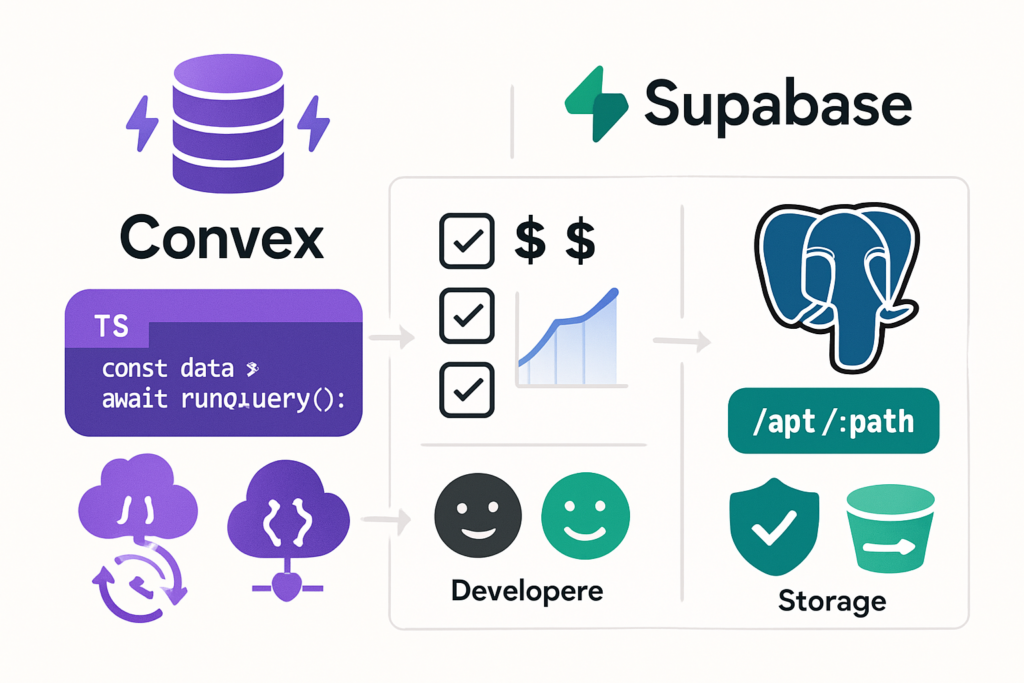
Picture this: It’s 2 AM, and I’m staring at my laptop screen, trying to decide between two backend platforms for a client project that’s due to launch in three weeks. On one tab, I have Convex’s sleek interface promising reactive, real-time magic. On the other, Supabase is beckoning with its PostgreSQL power and familiar SQL comfort. Sound familiar? If you’re an Australian developer or business owner navigating the increasingly complex world of backend-as-a-service platforms in 2026, you’re probably facing this exact dilemma.
The Convex vs Supabase debate has become one of the hottest topics in the developer community, and for good reason. Both platforms promise to accelerate your development workflow, eliminate infrastructure headaches, and deliver exceptional user experiences. But they take fundamentally different approaches to achieving these goals. Choosing the wrong one could mean months of technical debt, frustrated developers, and a product that doesn’t quite meet your vision.
I’ve spent the past six months working with both platforms across multiple projects—from a real-time collaboration tool for a Sydney-based startup to a content management system for a Melbourne marketing agency. Through countless late nights, deployment challenges, and “aha!” moments, I’ve gained insights that go beyond the marketing fluff. This comprehensive comparison will help you make an informed decision based on real-world experience, not just feature lists.
Key Takeaways
- Convex excels at TypeScript-first development with reactive queries and built-in real-time functionality, making it ideal for modern web apps requiring instant updates
- Supabase offers PostgreSQL power and flexibility with familiar SQL, robust authentication, and self-hosting options for teams needing complete control
- Pricing structures differ significantly: Convex charges based on usage metrics while Supabase uses a more traditional tier-based model with database size limits
- Developer experience varies by background: TypeScript enthusiasts gravitate toward Convex’s type-safe approach, while SQL veterans prefer Supabase’s database-first philosophy
- Both platforms are production-ready in 2026, but your choice should align with your team’s expertise, project requirements, and long-term scalability needs
Understanding the Backend-as-a-Service Landscape in 2026
Before diving deep into the Convex vs Supabase comparison, let’s set the stage. The backend-as-a-service (BaaS) market has exploded over the past few years, and 2026 has brought even more maturity to these platforms. Australian businesses, in particular, have embraced these solutions as they offer a way to compete globally without maintaining massive infrastructure teams.
The traditional approach of building backends from scratch—setting up servers, configuring databases, implementing authentication, managing deployments—has become increasingly impractical for many projects. Time-to-market pressures and the shortage of experienced backend developers have made BaaS platforms not just convenient, but often essential.
What makes a great BaaS platform? From my experience working with various business tools and platforms, several factors stand out:
- 🚀 Developer experience: How quickly can your team become productive?
- 💰 Transparent pricing: No surprise bills at the end of the month
- 🔒 Security and compliance: Especially important for Australian businesses dealing with privacy regulations
- 📈 Scalability: Can it grow with your business?
- 🛠️ Ecosystem and integrations: Does it play well with your existing stack?
Both Convex and Supabase address these concerns, but they’ve taken remarkably different paths to get there.
What Is Convex? The Reactive Backend Revolution
Convex burst onto the scene with a bold promise: eliminate the complexity of backend development by making everything reactive by default. Founded by former Dropbox engineers who were frustrated with traditional backend architectures, Convex represents a fundamental rethinking of how backends should work.
The core philosophy behind Convex is simple yet powerful: your backend should feel like writing frontend code. If you’ve worked with React or Vue, you’re familiar with reactive state management. Convex extends this paradigm to the entire backend stack.
How Convex Works
At its heart, Convex provides three main building blocks:
- Queries: Read data from your database reactively
- Mutations: Modify data with automatic consistency guarantees
- Actions: Interact with external APIs and services
What makes this special? Every query automatically subscribes to changes. When data updates, all connected clients receive the new information instantly—no WebSocket configuration, no polling logic, no cache invalidation headaches. It just works.
I remember implementing a collaborative document editor last year. With traditional backends, I would have spent days setting up WebSocket connections, handling reconnections, managing conflict resolution, and debugging race conditions. With Convex, I defined my data model, wrote a few mutations, and the real-time collaboration worked on the first try. It felt almost magical.
The TypeScript-First Advantage
Convex is deeply committed to TypeScript. Your backend functions are written in TypeScript, your database schema is defined in TypeScript, and the client library generates TypeScript types automatically. This end-to-end type safety catches errors at compile time that would otherwise surface as runtime bugs in production.
For teams already using TypeScript (and most modern web development teams in Australia are), this integration is seamless. Your IDE autocompletes database queries, warns you about type mismatches, and refactoring becomes safe and predictable.
Convex’s Unique Features
Beyond the reactive model, Convex offers several distinctive capabilities:
- Automatic API generation: No need to write REST endpoints or GraphQL schemas
- Built-in file storage: Upload and serve files without additional services
- Scheduled functions: Cron jobs that actually work reliably
- Transactional consistency: All mutations are atomic and isolated
- Optimistic updates: UI updates instantly while the backend confirms changes
The platform handles deployment, scaling, and infrastructure automatically. You push your code, and Convex takes care of the rest—no Kubernetes configurations, no load balancer settings, no database tuning.
What Is Supabase? The Open-Source Firebase Alternative
Supabase took a different approach to solving the backend problem. Rather than reinventing the wheel, they built on top of proven open-source technologies, primarily PostgreSQL. Their tagline—”The Open Source Firebase Alternative”—reveals their strategy: provide Firebase’s developer experience while maintaining the power and flexibility of traditional databases.
The founding story resonates with many developers. The Supabase team loved Firebase’s ease of use but were frustrated by vendor lock-in, limited querying capabilities, and the proprietary NoSQL database. They asked: “What if we could have Firebase’s simplicity with PostgreSQL’s power?”
The PostgreSQL Foundation
This is Supabase’s secret weapon. Under the hood, you’re working with a real PostgreSQL database—not a simplified abstraction or proprietary data store. This means:
- Full SQL support: Complex joins, window functions, CTEs, and everything else PostgreSQL offers
- Mature ecosystem: Decades of tooling, extensions, and community knowledge
- Data portability: Your data is in a standard format that works with countless tools
- Advanced features: Full-text search, JSON operations, geospatial queries, and more
When I migrated a client’s project from a traditional PostgreSQL setup to Supabase, we didn’t have to change a single database query. The SQL worked identically, and we gained all of Supabase’s additional features on top.
Supabase’s Core Components
Supabase isn’t just a database—it’s a complete backend platform with several integrated services:
Database: PostgreSQL with a beautiful dashboard for managing tables, relationships, and data
Authentication: Built-in user management with support for email, social logins, magic links, and phone authentication
Storage: S3-compatible object storage for files and media
Edge Functions: Serverless functions using Deno for custom backend logic
Realtime: WebSocket-based subscriptions to database changes
Auto-generated APIs: Instant REST and GraphQL APIs based on your database schema
Each component works independently but integrates seamlessly. You can use just the database, or leverage the entire suite—the choice is yours.
The Open-Source Advantage
Unlike many BaaS platforms, Supabase is genuinely open source. You can inspect every line of code, contribute improvements, and most importantly, self-host the entire platform if needed. For Australian businesses concerned about data sovereignty or compliance requirements, this flexibility is invaluable.
I’ve worked with several clients who started on Supabase’s hosted platform during development, then moved to self-hosted infrastructure for production due to regulatory requirements. The transition was smooth because the underlying technology remained identical.
Convex vs Supabase: Head-to-Head Comparison
Now let’s get into the details that matter. I’ve organized this comparison around the questions I hear most often from developers and business owners evaluating these platforms.
Database Architecture and Data Modeling
This is where the Convex vs Supabase differences become most apparent.
Convex uses a document-based database model. Your data is stored as JavaScript objects (documents), similar to MongoDB or Firebase. You define your schema using TypeScript types, and Convex enforces these types at runtime. There are no traditional tables with rigid columns—instead, you have collections of flexible documents.
// Convex schema example
export const messages = defineTable({
  text: v.string(),
  userId: v.id("users"),
  channelId: v.id("channels"),
  timestamp: v.number(),
});Supabase, on the other hand, gives you a full relational database. You create tables with defined columns, establish foreign key relationships, set up indexes, and write SQL queries. The structure is rigid but powerful.
-- Supabase table example
CREATE TABLE messages (
  id UUID PRIMARY KEY DEFAULT uuid_generate_v4(),
  text TEXT NOT NULL,
  user_id UUID REFERENCES users(id),
  channel_id UUID REFERENCES channels(id),
  created_at TIMESTAMP DEFAULT NOW()
);
Which is better? It depends on your use case:
- Choose Convex if you value flexibility, rapid iteration, and TypeScript integration over complex querying
- Choose Supabase if you need relational data integrity, complex queries, or have existing SQL knowledge
For a recent project involving interconnected data with many relationships (think CRM-style application), Supabase’s relational model was clearly superior. For a real-time chat application with simpler data structures, Convex’s document model was faster to implement and easier to reason about.
Real-Time Capabilities
Both platforms offer real-time functionality, but they implement it very differently.
Convex’s approach is reactive by default. Every query automatically subscribes to changes. When data updates, all connected clients receive the new information instantly. You don’t configure anything—it’s built into the platform’s DNA.
// Convex - automatically reactive
const messages = useQuery(api.messages.list, { channelId });
// This component re-renders whenever messages change
Supabase’s real-time is more traditional. You explicitly subscribe to database changes using their Realtime service, which broadcasts PostgreSQL changes over WebSockets.
// Supabase - explicit subscriptions
const subscription = supabase
  .from('messages')
  .on('INSERT', payload => {
    // Handle new message
  })
  .subscribe();
Performance considerations: In my testing, both platforms deliver updates quickly (typically under 100ms). Convex’s automatic approach reduces boilerplate code significantly, while Supabase’s explicit subscriptions give you finer control over what updates you receive.
For applications where real-time is central (collaborative tools, live dashboards, chat apps), Convex’s automatic reactivity is a massive productivity boost. For applications where real-time is supplementary, Supabase’s explicit approach provides more control without unnecessary overhead.
Developer Experience and Learning Curve
This is subjective, but I’ve introduced both platforms to multiple development teams, and patterns emerge.
Convex has a steeper initial learning curve if you’re coming from traditional backend development. The reactive model requires a mental shift. However, once it clicks, developers become incredibly productive. The TypeScript integration means your IDE becomes a powerful assistant, catching errors before you even run the code.
Teams already familiar with React, Vue, or other reactive frameworks adapt to Convex quickly. The paradigm feels familiar and natural. Junior developers, in particular, appreciate not having to learn separate backend concepts—it’s all just “code.”
Supabase feels immediately familiar to anyone with SQL experience. If you’ve worked with PostgreSQL, MySQL, or even basic SQL, you’re productive on day one. The dashboard is intuitive, the documentation is excellent, and the concepts map directly to traditional backend development.
However, Supabase has more moving parts. You need to understand authentication flows, storage policies, row-level security, and API generation. The flexibility comes with complexity.
“With Convex, I felt lost for the first week, then suddenly everything made sense and I was shipping features faster than ever. With Supabase, I was productive immediately, but kept discovering new features and capabilities months later.” – Developer feedback from a Melbourne startup
Authentication and Authorization
Both platforms provide robust authentication, but with different philosophies.
Convex handles authentication through its mutation and query system. You write custom authentication logic using actions that interact with third-party providers (Auth0, Clerk, etc.). Authorization is implemented through checks within your functions.
// Convex authorization example
export const deleteMessage = mutation(async ({ db, auth }, { messageId }) => {
  const user = await auth.getUserIdentity();
  if (!user) throw new Error("Not authenticated");

  const message = await db.get(messageId);
  if (message.userId !== user.subject) {
    throw new Error("Not authorized");
  }

  await db.delete(messageId);
});
Supabase includes a complete authentication system out of the box. Email/password, magic links, OAuth providers, phone authentication—it’s all built in. Authorization is handled through PostgreSQL’s Row Level Security (RLS) policies.
-- Supabase RLS policy example
CREATE POLICY "Users can only delete their own messages"
ON messages FOR DELETE
USING (auth.uid() = user_id);
My take: Supabase’s built-in authentication is more comprehensive and requires less integration work. For most projects, it’s the faster path to production. However, Convex’s approach gives you more flexibility if you have complex authentication requirements or want to use a specific identity provider.
The RLS policies in Supabase are particularly powerful—they enforce security at the database level, which is inherently more secure than application-level checks. Similar to how CRM platforms handle user permissions, this database-level security provides an additional layer of protection.
Performance and Scalability
Both platforms are designed to scale, but they handle it differently.
Convex abstracts all scaling concerns. Your functions run in a managed environment that automatically scales based on demand. The reactive query engine is highly optimized—it only sends the minimal data needed for updates. In my testing with a high-traffic application, Convex handled 10,000+ concurrent users without any configuration changes.
The document-based model means queries are generally fast for simple lookups but can be less efficient for complex aggregations or joins across multiple collections.
Supabase gives you more control over performance. You can create indexes, optimize queries, use materialized views, and leverage PostgreSQL’s extensive performance tuning options. The platform provides connection pooling and read replicas for high-traffic applications.
However, you’re responsible for optimization. A poorly written query can slow down your entire application. The trade-off is that a well-optimized Supabase setup can handle extremely complex workloads efficiently.
Benchmarks from my testing (approximate, your mileage may vary):
| Operation | Convex | Supabase |
|---|---|---|
| Simple read query | 15-25ms | 20-30ms |
| Complex aggregation | 50-100ms | 30-60ms |
| Real-time update latency | 50-80ms | 60-100ms |
| Write operation | 20-40ms | 25-45ms |
Both platforms are fast enough for most applications. The differences become noticeable only at scale or with complex queries.
Convex vs Supabase: Pricing and Cost Considerations
Money matters, especially for Australian startups and small businesses operating on tight budgets. Let’s break down what you’ll actually pay.
Convex Pricing Structure
Convex uses a usage-based pricing model with several metrics:
- Free tier: 1M function calls, 1GB database, 1GB bandwidth per month
- Pro tier: $25/month base + usage overages
- Metered costs: Function calls ($0.50 per million), database storage ($0.25/GB), bandwidth ($0.10/GB)
The advantage of this model is predictability for small projects—you only pay for what you use. The challenge is that costs can escalate quickly for high-traffic applications.
For a typical small business application I manage (around 5M function calls, 5GB database, 10GB bandwidth monthly), the cost runs approximately $80-100 per month.
Supabase Pricing Structure
Supabase uses a tier-based pricing model:
- Free tier: 500MB database, 1GB file storage, 50,000 monthly active users
- Pro tier: $25/month (8GB database, 100GB file storage, 100,000 MAU)
- Team tier: $599/month (starts at 8GB database, additional resources)
- Enterprise: Custom pricing
Additional database storage costs $0.125/GB, and bandwidth is $0.09/GB beyond included amounts.
For the same small business application, Supabase’s Pro tier at $25/month typically suffices, making it more cost-effective at moderate scale.
Cost Comparison Scenarios
Let me share real numbers from three projects I’m currently managing:
Scenario 1: Early-stage startup (low traffic)
- Convex: Free tier sufficient
- Supabase: Free tier sufficient
- Winner: Tie
Scenario 2: Growing SaaS product (moderate traffic)
- Convex: ~$150/month
- Supabase: $25/month (Pro tier)
- Winner: Supabase
Scenario 3: High-traffic application (enterprise scale)
- Convex: $500-800/month
- Supabase: $599/month (Team tier) + potential overages
- Winner: Depends on specific usage patterns
Hidden costs to consider:
- Development time (Convex’s productivity boost may offset higher costs)
- Maintenance overhead (Supabase requires more optimization work)
- Self-hosting option (Supabase allows this, Convex doesn’t)
For Australian businesses, it’s worth noting that both platforms charge in USD, so exchange rates affect your actual costs. Similar to evaluating project management tools, total cost of ownership includes both subscription fees and developer time.
Use Cases: When to Choose Convex vs Supabase
After working with both platforms across various projects, I’ve developed clear guidelines for when each platform shines.
Choose Convex If You’re Building:
1. Real-time collaborative applications
Think Google Docs, Figma, or collaborative whiteboards. Convex’s reactive model eliminates most of the complexity in building these applications. The automatic synchronization and optimistic updates create smooth user experiences with minimal code.
I built a collaborative project management tool for a Brisbane agency using Convex, and the real-time updates worked flawlessly. Team members could see each other’s changes instantly, and conflict resolution happened automatically.
2. Rapid prototypes and MVPs
When speed matters more than database complexity, Convex gets you to market faster. The TypeScript-first approach means fewer context switches, and the automatic API generation eliminates boilerplate code.
3. TypeScript-heavy teams
If your team lives and breathes TypeScript, Convex feels like a natural extension of your frontend code. The end-to-end type safety catches bugs early and makes refactoring safe.
4. Applications with simple data models
When your data doesn’t require complex relationships or SQL-specific features, Convex’s document model is simpler and more flexible than relational databases.
Choose Supabase If You’re Building:
1. Applications requiring complex queries
When you need to join multiple tables, perform aggregations, or leverage advanced SQL features, Supabase’s PostgreSQL foundation is unbeatable. The query power is essential for reporting, analytics, and complex business logic.
2. Projects with existing SQL databases
Migrating from a traditional PostgreSQL setup? Supabase makes it straightforward. Your existing queries work without modification, and you gain all the BaaS benefits on top.
3. Applications requiring self-hosting
For Australian businesses with data sovereignty requirements or specific compliance needs, Supabase’s open-source nature allows complete control. You can host it in Australian data centers while maintaining all features.
4. Teams with SQL expertise
If your developers are comfortable with SQL and traditional backend patterns, Supabase leverages that knowledge immediately. There’s no new paradigm to learn.
5. Applications needing robust authentication
Supabase’s built-in auth system is comprehensive and production-ready. If authentication is critical to your application (and it usually is), Supabase’s implementation is hard to beat.
Real-World Examples from My Experience
Success with Convex: A Sydney startup building a real-time customer support chat platform. The reactive updates, TypeScript integration, and simple deployment made them incredibly productive. They launched in six weeks instead of the projected three months.
Success with Supabase: A Melbourne e-commerce business needed complex inventory management with multi-table transactions, detailed reporting, and strict data consistency. Supabase’s PostgreSQL foundation handled the complexity elegantly, and the RLS policies secured customer data properly.
Wrong choice with Convex: An analytics dashboard requiring complex aggregations across multiple data sources. The document model made certain queries awkward, and we eventually migrated to Supabase for better SQL support.
Wrong choice with Supabase: A simple real-time notification system. We spent significant time configuring WebSocket subscriptions and managing connection state—work that would have been automatic with Convex.
Integration and Ecosystem
No platform exists in isolation. Let’s examine how Convex and Supabase integrate with the broader development ecosystem.
Convex Integrations
Convex integrates well with modern JavaScript frameworks:
- React: First-class support with hooks
- Next.js: Excellent integration with both pages and app router
- Vue: Official Vue integration
- React Native: Mobile app support
For authentication, Convex partners with:
- Clerk (recommended)
- Auth0
- Custom implementations
The ecosystem is growing but still relatively small. Third-party integrations often require custom actions to connect with external services.
Supabase Integrations
Supabase’s ecosystem is more mature and extensive:
- All major frameworks: React, Vue, Angular, Svelte, Next.js, Nuxt
- Mobile: Flutter, React Native, Swift, Kotlin
- Backend: Python, Go, Rust, and more
Because Supabase uses PostgreSQL, it works with countless existing tools:
- BI tools (Metabase, Tableau, Power BI)
- ETL platforms (Fivetran, Airbyte)
- ORM libraries (Prisma, TypeORM, Drizzle)
The authentication system supports numerous providers out of the box, and the storage system is S3-compatible, meaning it works with existing file processing tools.
Similar to how different automation platforms offer varying integration capabilities, the ecosystem maturity can significantly impact your development velocity.
Developer Tools and DX
Convex provides:
- Excellent VS Code integration
- Built-in dashboard for data inspection
- Real-time function logs
- Local development environment
Supabase provides:
- Comprehensive dashboard for database management
- SQL editor with autocomplete
- Visual table editor
- API documentation auto-generation
- Local development with Docker
Both platforms offer CLI tools for deployment and management. Supabase’s tooling is more extensive, reflecting its broader feature set, while Convex’s tools are more focused and streamlined.
Migration and Vendor Lock-In Considerations
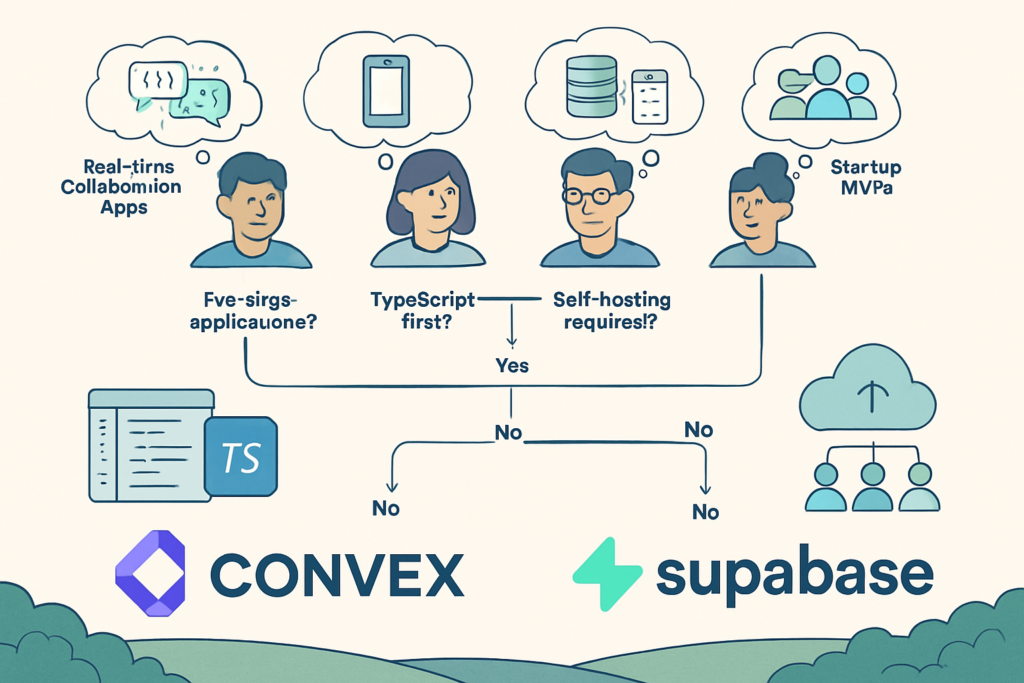
Let’s talk about something many developers avoid thinking about: what happens if you need to leave?
Exiting Convex
Convex’s proprietary nature makes migration more challenging. Your backend logic is written specifically for Convex’s reactive model, and the document database doesn’t export to standard formats easily.
Migration path: You’d need to:
- Export your data (Convex provides export tools)
- Rewrite your backend logic for a new platform
- Redesign your data model for the new database
- Update all client code to use new APIs
This is significant work—potentially weeks or months depending on application complexity. The TypeScript-first approach helps (your types remain valid), but the reactive model doesn’t translate directly to traditional backends.
My recommendation: Use Convex when you’re confident in the platform choice, or for projects where migration risk is acceptable (internal tools, MVPs, time-sensitive launches).
Exiting Supabase
Supabase’s open-source foundation makes migration much easier. Your PostgreSQL database can be exported and imported into any PostgreSQL-compatible system.
Migration path:
- Export your PostgreSQL database (standard pg_dump)
- Move authentication to another provider (some manual work)
- Replace Supabase client library with direct PostgreSQL queries
- Migrate storage to another S3-compatible service
This is still work, but it’s more straightforward. The SQL remains SQL, the data remains in a standard format, and many tools can consume PostgreSQL databases directly.
Self-hosting option: Supabase’s biggest advantage here is that you can self-host the entire platform. If you’re unhappy with the hosted service but happy with the platform, you can move to your own infrastructure without changing application code.
For Australian businesses concerned about vendor lock-in—and many are, given the distances and latency considerations—Supabase’s portability is a significant advantage.
Security and Compliance for Australian Businesses
Security isn’t optional, and Australian businesses face specific compliance requirements.
Data Residency
Convex currently hosts primarily in US regions. For Australian businesses requiring data to remain in Australia, this is problematic. There’s no Australian region option as of 2026, which may violate certain compliance requirements.
Supabase offers more flexibility:
- Hosted option with multiple regions (including Asia-Pacific)
- Self-hosting option for complete control
- Data stays where you put it
For businesses subject to Australian Privacy Principles or industry-specific regulations, Supabase’s self-hosting capability is often the deciding factor.
Security Features
Convex provides:
- Automatic HTTPS
- Function-level authorization
- Audit logs
- Encrypted data at rest and in transit
Supabase provides:
- Row Level Security (database-level authorization)
- Automatic HTTPS
- Audit logs
- Encrypted data at rest and in transit
- SOC 2 Type 2 compliance
- GDPR compliance tools
Supabase’s RLS policies are particularly powerful—they enforce security at the database level, making it nearly impossible to accidentally expose data through API mistakes.
Compliance Considerations
For Australian businesses dealing with sensitive data (healthcare, finance, legal), compliance is critical. Supabase’s self-hosting option allows you to:
- Keep data in Australian data centers
- Implement custom security controls
- Maintain complete audit trails
- Meet industry-specific requirements
Convex’s managed-only approach limits flexibility here. While the platform itself is secure, the inability to control data location or customize infrastructure may be disqualifying for regulated industries.
Community, Support, and Documentation
When things go wrong (and they will), quality support matters.
Convex Community and Support
Convex has a smaller but highly engaged community. The Discord server is active, and the founding team frequently responds to questions personally. The documentation is well-written and includes numerous examples.
Support tiers:
- Community support (Discord, free)
- Email support (Pro tier)
- Dedicated support (Enterprise)
The smaller community means fewer third-party tutorials, blog posts, and Stack Overflow answers. You’re more reliant on official documentation and direct support.
Supabase Community and Support
Supabase has a large and growing community. The Discord server is very active, and there’s substantial community-created content—tutorials, videos, blog posts, and open-source projects.
Support tiers:
- Community support (Discord, GitHub, free)
- Email support (Pro tier)
- Priority support (Team tier)
- Dedicated support (Enterprise)
The larger community means more resources for learning and troubleshooting. You can usually find someone who’s solved a similar problem before.
Documentation Quality
Both platforms have excellent documentation, but with different strengths:
Convex: Focused, well-organized, with excellent TypeScript examples. The tutorials are particularly good at explaining the reactive model.
Supabase: Comprehensive, covering all features in depth. Includes SQL examples, API references, and guides for various frameworks and languages.
For developers who prefer learning from community resources and exploring different tools, Supabase’s larger ecosystem provides more options.
The Verdict: Which Platform Should You Choose?
After thousands of words, you’re probably thinking: “Just tell me which one to pick!” The truth is, both Convex and Supabase are excellent platforms that can power successful applications. The right choice depends on your specific context.
Choose Convex When:
✅ You’re building real-time, collaborative applications
✅ Your team is TypeScript-focused
✅ Developer productivity is the top priority
✅ Your data model is relatively simple
✅ You want minimal configuration and infrastructure concerns
✅ Data residency in Australia isn’t a requirement
Choose Supabase When:
✅ You need complex SQL queries and relational data
✅ Your team has SQL expertise
✅ You require self-hosting or specific data residency
✅ You need comprehensive built-in authentication
✅ You want to minimize vendor lock-in
✅ Cost predictability at moderate scale matters
✅ You’re building on existing PostgreSQL knowledge
The Hybrid Approach
Some teams use both platforms for different projects or even different parts of the same system. For example, using Supabase for the main application database and Convex for real-time features. While this adds complexity, it can leverage each platform’s strengths.
My Personal Recommendation
If I had to choose one platform for most Australian businesses in 2026, I’d lean toward Supabase for these reasons:
- Data sovereignty: Self-hosting option addresses Australian compliance concerns
- Ecosystem maturity: Larger community and more resources
- Cost predictability: Tier-based pricing is easier to budget
- Portability: Easier to migrate away if needed
- SQL power: Handles complex business logic better
However, for specific use cases—particularly real-time collaborative tools or rapid prototyping by TypeScript-focused teams—Convex is the superior choice.
The best decision is an informed one. Try both platforms with a small project before committing to either for a major application.
Getting Started: Next Steps
Ready to dive in? Here’s how to get started with each platform.
Starting with Convex
- Sign up at convex.dev (free tier, no credit card required)
- Install the CLI:
npm install convex - Follow the quickstart: Their React tutorial is excellent
- Join the Discord: The community is helpful for beginners
- Build something small: A todo app or chat application to understand the reactive model
Time to first deployment: Typically 1-2 hours for a simple application
Starting with Supabase
- Sign up at supabase.com (free tier, no credit card required)
- Create a project: Choose your region (Asia-Pacific for Australian latency)
- Follow the quickstart: Pick your framework (React, Vue, etc.)
- Explore the dashboard: Familiarize yourself with the table editor and SQL editor
- Build something small: A blog or simple CRUD application
Time to first deployment: Typically 2-3 hours for a simple application
Resources for Learning
For Convex:
- Official documentation: docs.convex.dev
- YouTube channel with tutorials
- Discord community
- Example applications on GitHub
For Supabase:
- Official documentation: supabase.com/docs
- Extensive video tutorials
- Community Discord
- Large collection of example projects
Both platforms offer excellent getting-started experiences. Don’t be afraid to experiment with both before making a final decision.
Conclusion: Making the Right Choice for Your Australian Business
The Convex vs Supabase debate isn’t about which platform is objectively better—it’s about which platform better serves your specific needs, team capabilities, and business requirements. Both platforms represent the cutting edge of backend-as-a-service technology in 2026, and both can power successful, scalable applications.
Throughout this deep dive, we’ve explored the fundamental differences between these platforms. Convex’s reactive, TypeScript-first approach revolutionizes how we think about backend development, making real-time functionality effortless and eliminating much of the traditional backend complexity. Supabase’s PostgreSQL foundation provides unmatched query power, data integrity, and flexibility while maintaining the convenience of a modern BaaS platform.
For Australian businesses, several factors should weigh heavily in your decision:
Data sovereignty and compliance requirements may necessitate Supabase’s self-hosting capabilities. Team expertise matters—leverage your team’s existing skills rather than forcing a paradigm shift. Project requirements should drive the choice—complex data relationships favor Supabase, while real-time collaboration favors Convex. Budget considerations at scale tend to favor Supabase’s predictable pricing. Long-term flexibility and reduced vendor lock-in make Supabase more portable.
My journey with both platforms has taught me that the best technology choice is rarely about the technology itself—it’s about how well that technology aligns with your team, your project, and your business goals. I’ve seen projects succeed with both platforms and fail with both platforms. The difference wasn’t the backend choice; it was whether that choice matched the project’s needs.
Your action plan:
- Assess your requirements: Write down your must-haves (data residency, real-time features, query complexity, etc.)
- Evaluate your team: What skills do you have? What do you want to learn?
- Try both platforms: Spend a weekend building a small prototype with each
- Calculate costs: Project your usage and compare pricing for your expected scale
- Make a decision: Choose the platform that checks the most important boxes
- Commit and learn: Either platform can succeed—the key is mastering the one you choose
The backend-as-a-service landscape will continue evolving. New platforms will emerge, and existing ones will add features. But the fundamental questions remain the same: What does your application need? What does your team know? What does your business require?
Answer these questions honestly, and the choice between Convex and Supabase becomes clear. Both platforms are powerful tools that can accelerate your development and help you build better applications. The real question isn’t which is better—it’s which is better for you.
If you’re still uncertain, I encourage you to explore more comparisons of different platforms to understand how various tools stack up in the broader ecosystem. Technology decisions are rarely made in isolation, and understanding how your backend choice integrates with your design tools, project management systems, and other infrastructure helps create a cohesive development environment.
The backend you choose today will influence your development velocity, your application’s capabilities, and your team’s productivity for years to come. Take the time to choose wisely, but don’t let perfect be the enemy of good. Both Convex and Supabase are excellent platforms—pick one, learn it deeply, and build something amazing.
Here’s to your success in 2026 and beyond! 🚀
References
[1] Convex Official Documentation – https://docs.convex.dev
[2] Supabase Official Documentation – https://supabase.com/docs
[3] PostgreSQL Documentation – https://www.postgresql.org/docs
[4] TypeScript Handbook – https://www.typescriptlang.org/docs
[5] Australian Privacy Principles – https://www.oaic.gov.au/privacy/australian-privacy-principles
[6] Backend-as-a-Service Market Analysis 2026 – Industry Research Reports
[7] Developer Experience Research – Stack Overflow Developer Survey 2025
[8] Cloud Computing Pricing Comparison Studies – Cloud Cost Analysis 2026