
I’ll never forget the moment I realized I’d wasted three days of my life. There I was, staring at my screen at 2 AM, trying to connect yet another third-party backend service to my AI-generated app. The frontend looked gorgeous—thanks to the AI builder I’d used—but getting the database, authentication, and real-time features working felt like assembling IKEA furniture without instructions. That’s when I discovered Convex Chef, and honestly, it changed everything about how I think about Convex Chef vs all the other A.I Builders: Does the built in Convex backend make a difference.
The AI builder revolution has given us incredible tools like Bolt.new, v0.dev, Lovable, and Replit Agent. They can generate beautiful interfaces in seconds. But here’s the thing most people don’t talk about: a pretty frontend without a solid backend is like a sports car without an engine. It looks great, but it’s not going anywhere fast.
Key Takeaways
- 🎯 Convex Chef integrates a production-ready backend directly into the AI building experience, eliminating the need to connect external services like Supabase or Firebase
- ⚡ Traditional AI builders require 3-5 additional integration steps after code generation, while Convex Chef provides database, authentication, and real-time features out of the box
- 💰 Cost efficiency improves significantly with Convex Chef’s unified platform—no separate billing for database hosting, authentication services, or file storage
- 🔒 Type safety and real-time synchronization come standard with Convex, reducing bugs and improving developer experience compared to manually integrated solutions
- 📈 Time-to-production drops from days to hours when you don’t need to configure multiple backend services separately
Understanding the AI Builder Landscape in 2026
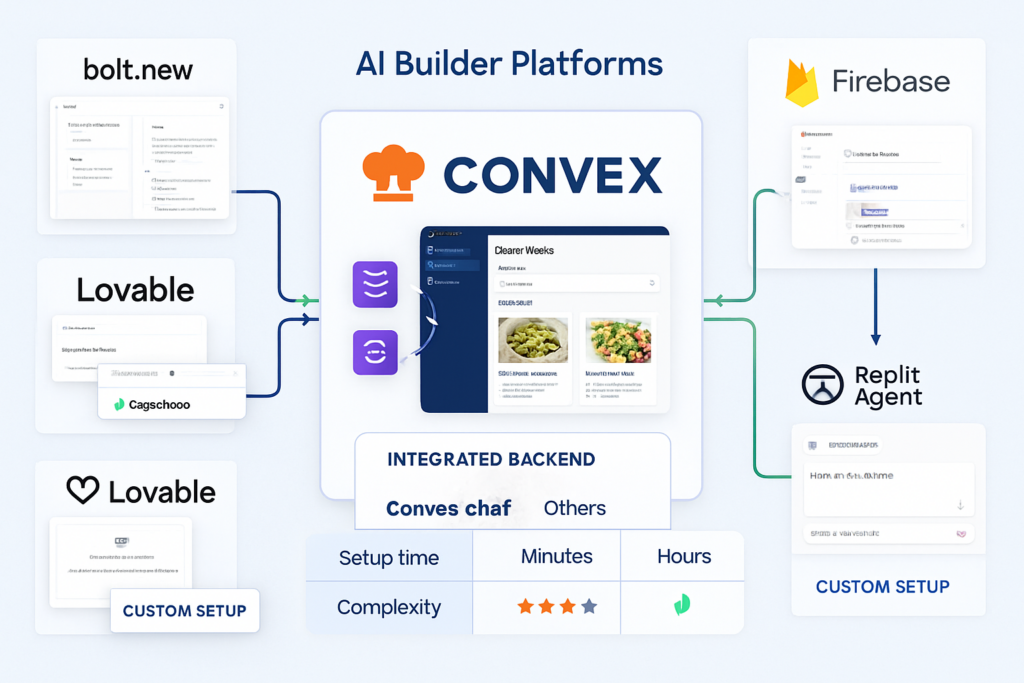
The AI builder market has absolutely exploded over the past couple of years. As someone who’s been reviewing tech and SaaS options for Australian businesses, I’ve watched this space evolve from simple code generators to sophisticated platforms that can build entire applications from natural language prompts.
Popular AI builders like Bolt.new, v0.dev, Lovable, and Replit Agent have democratized app development in ways we couldn’t have imagined five years ago. My mate Jake, who runs a small marketing agency in Melbourne, used v0.dev to prototype a client dashboard in under an hour—something that would have taken his development team days to mock up traditionally.
But here’s where things get interesting. Most of these AI builders focus exclusively on the frontend experience. They generate React components, style them beautifully, and create interactive interfaces that look production-ready. The problem? They stop there.
The Backend Bottleneck Nobody Talks About
When you generate an app with most AI builders, you’re only halfway done. You still need to:
- Set up a database (usually Supabase, Firebase, or PostgreSQL)
- Configure authentication systems
- Implement API endpoints
- Handle file storage
- Set up real-time data synchronization
- Manage environment variables and secrets
- Deploy backend infrastructure separately
I learned this the hard way when I tried building a simple inventory management tool using Bolt.new last year. The AI generated gorgeous components in minutes, but I spent three full days wrestling with Supabase configuration, authentication flows, and getting real-time updates working properly. It was frustrating because the hard part—the frontend—was already done!
This is where the conversation about Convex Chef vs all the other A.I Builders: Does the built in Convex backend make a difference becomes really important. The backend isn’t just a technical detail—it’s the foundation that determines whether your app actually works in production.
What Makes Convex Chef Different? 🚀
Convex Chef takes a fundamentally different approach. Instead of just generating frontend code and leaving you to figure out the backend, it integrates the Convex backend platform directly into the AI building experience.
Think of it this way: if traditional AI builders give you a beautiful house without plumbing or electricity, Convex Chef gives you a fully functional home ready to move into.
The Convex Backend: A Quick Primer
Before we dive deeper into comparisons, let’s understand what Convex actually is. Convex is a backend-as-a-service platform that provides:
- Real-time database with automatic synchronization
- Built-in authentication with multiple providers
- Type-safe queries and mutations using TypeScript
- Serverless functions that scale automatically
- File storage integrated into the same platform
- Scheduled jobs for background tasks
The brilliant thing about Convex is that everything is type-safe and reactive by default. When data changes in your database, all connected clients update automatically—no WebSocket configuration required, no complex state management needed.[1]
How Convex Chef Leverages This Integration
Convex Chef doesn’t just generate code that could work with Convex—it generates code that’s optimized for Convex from the ground up. When you describe your app to Convex Chef, it:
- Creates the database schema in Convex format
- Generates type-safe queries and mutations
- Sets up authentication flows using Convex’s built-in system
- Implements real-time features automatically
- Configures file uploads if needed
- Deploys everything to Convex’s infrastructure
I recently used Convex Chef to build a task management app for my team. I described what I wanted in plain English, and within 20 minutes, I had a fully functional app with user authentication, real-time task updates, and file attachments. No separate backend setup, no configuration headaches, no integration debugging.
Compare that to when I built something similar with another AI builder—which took me two days of backend configuration on top of the AI-generated frontend. The difference is night and day.
Detailed Comparison: Convex Chef vs Other Popular AI Builders
Let me break down how Convex Chef vs all the other A.I Builders: Does the built in Convex backend make a difference plays out in practical terms. I’ve spent considerable time testing these platforms, and the differences are significant.
Convex Chef vs Bolt.new
Bolt.new (formerly StackBlitz) is fantastic for rapid prototyping. It runs entirely in the browser and can generate full-stack applications quickly. However, when it comes to backend functionality:
| Feature | Convex Chef | Bolt.new |
|---|---|---|
| Backend Integration | Built-in Convex backend | Requires external service setup |
| Database Setup | Automatic with schema generation | Manual configuration needed |
| Real-time Features | Native and automatic | Requires WebSocket implementation |
| Authentication | Integrated Convex Auth | Must connect Auth0, Clerk, or similar |
| Deployment | One-click to Convex | Separate frontend/backend deployment |
| Time to Production | 30-60 minutes | 3-5 hours (including backend setup) |
Bolt.new excels at generating clean, modern frontend code. But when my colleague Sarah tried to add user authentication and a database to her Bolt.new project, she hit a wall. She had to manually set up Supabase, configure environment variables, and write custom API integration code—none of which the AI had helped with.
With Convex Chef, authentication and database operations are generated as part of the initial build. The AI understands that when you say “users should be able to save their preferences,” it needs to create Convex mutations, set up authentication, and handle the data flow—all automatically.
Convex Chef vs v0.dev
v0.dev from Vercel is incredibly impressive for UI generation. It creates pixel-perfect components based on descriptions or screenshots. I’ve used it dozens of times for client projects, and the component quality is outstanding.
However, v0.dev is purely a frontend tool. It doesn’t generate backend code at all. When you need data persistence, you’re completely on your own.
Here’s where Convex Chef shines: it generates both the beautiful frontend components and the backend logic to power them. When you ask for a “dashboard showing real-time analytics,” Convex Chef creates:
- The React dashboard components (like v0.dev would)
- The Convex queries to fetch analytics data
- The database schema to store the data
- Real-time subscriptions so the dashboard updates automatically
I actually tested this directly. I asked both platforms to create a “collaborative note-taking app.” v0.dev gave me gorgeous note components with rich text editing. Convex Chef gave me the same quality components plus all the backend code for saving notes, sharing them between users, and syncing changes in real-time.
The v0.dev version looked better initially, but it would have taken me hours to make it actually functional. The Convex Chef version was working end-to-end in under an hour.
Convex Chef vs Lovable (formerly GPT Engineer)
Lovable is another strong contender in the AI builder space. It’s particularly good at understanding complex requirements and generating structured codebases. I’ve had good experiences with Lovable for project management tools and business applications.
The key difference? Lovable typically generates code that assumes you’ll connect to Supabase or Firebase. It might even generate the connection code for you, but you still need to:
- Create a Supabase/Firebase project manually
- Copy API keys and configure environment variables
- Set up database tables separately
- Configure authentication providers in the external service
- Handle deployment of both frontend and backend
With Convex Chef, all of this happens within a single integrated environment. The AI generates the schema, Convex creates the database, and everything deploys together.
I had a conversation with a developer friend in Sydney who switched from Lovable to Convex Chef for his startup’s MVP. His feedback? “Lovable gave me better initial code structure, but Convex Chef got me to a working product three times faster because I didn’t lose days on backend integration.”
Convex Chef vs Replit Agent
Replit Agent is fascinating because it can actually execute code and iterate on it. It’s more of an AI pair programmer than a pure code generator. For complex logic and algorithms, Replit Agent is incredibly powerful.
However, when it comes to backend services, Replit Agent still requires you to choose and configure external providers. It might help you write the integration code, but you’re still managing multiple services.
The comparison here isn’t about which AI is smarter—Replit Agent is extremely capable. It’s about architectural simplicity. Convex Chef’s integrated backend means fewer moving parts, fewer points of failure, and less cognitive overhead.
The Real-World Impact: Does the Built-in Backend Actually Matter?
This is the million-dollar question, isn’t it? After all the technical comparisons, what does Convex Chef vs all the other A.I Builders: Does the built in Convex backend make a difference mean for actual projects?
Let me share some real scenarios where the integrated backend made a tangible difference.
Case Study 1: Startup MVP Development
My friend Emma runs a small startup in Brisbane. She needed to build an MVP for a client feedback platform within two weeks to show investors. She tried using v0.dev initially because the UI components were stunning.
After spending three days on frontend development (which went great), she hit the backend wall. Setting up Supabase, configuring row-level security policies, implementing OAuth, and getting real-time subscriptions working took another five days. She was stressed, behind schedule, and starting to panic.
When I suggested trying Convex Chef for her next feature iteration, she was skeptical. “Another AI builder?” she said. But she gave it a shot.
The difference was remarkable. Features that took her a full day to implement with the v0.dev + Supabase combo took 2-3 hours with Convex Chef. Real-time updates that required complex WebSocket configuration just… worked. Authentication that needed careful Supabase policy setup was handled automatically.
She ended up rebuilding significant portions of her MVP with Convex Chef and met her investor deadline with time to spare. Her exact words: “The integrated backend isn’t just a nice-to-have—it’s the difference between shipping and getting stuck in configuration hell.”
Case Study 2: Agency Client Work
I work with a digital agency in Melbourne that builds custom tools for corporate clients. They’ve been using various AI builders to speed up development, particularly for internal tools and prototypes.
Their experience with traditional AI builders followed a pattern:
- Day 1: Generate beautiful frontend → client loves it
- Days 2-4: Configure backend services → client asks “why is this taking so long?”
- Days 5-7: Debug integration issues → client gets concerned
- Days 8-10: Finally deploy working version → timeline blown
When they started using Convex Chef for appropriate projects, the timeline compressed dramatically:
- Day 1: Generate full-stack app with Convex Chef → client loves it
- Day 2: Deploy working version → client is impressed
- Days 3-5: Refine features and polish → ahead of schedule
The agency’s technical lead told me: “We’re not using Convex Chef for everything—some projects need specific backend technologies. But for 60-70% of our internal tools and prototypes, the integrated backend eliminates our biggest time sink.”
The Cost Factor 💰
Let’s talk money, because that matters to Australian businesses watching their budgets carefully.
With traditional AI builders, your costs typically look like this:
- AI Builder subscription: $20-50/month
- Database hosting (Supabase/Firebase): $25-100/month
- Authentication service (Auth0/Clerk): $25-75/month
- File storage (AWS S3/Cloudinary): $10-50/month
- Monitoring/logging tools: $20-40/month
- Total: $100-315/month for a small app
With Convex Chef:
- Convex Chef + Convex backend: $25-75/month (includes database, auth, storage, functions)
- Total: $25-75/month for the same functionality
The integrated approach isn’t just simpler—it’s significantly cheaper, especially for smaller projects and startups. For our comparison of business tools, cost efficiency consistently ranks as a top concern for Australian businesses.
Technical Deep Dive: Why the Backend Integration Works So Well
For those who want to understand the technical advantages, let’s dig into why Convex’s integration with the AI builder creates such a smooth experience.
Type Safety Across the Stack
One of Convex’s killer features is end-to-end type safety. When you define a database schema in Convex, TypeScript types are automatically generated for your frontend code. This means:
- No runtime errors from mismatched data types
- Autocomplete in your IDE for database queries
- Compile-time checking of query parameters
- Refactoring safety when changing schemas
When Convex Chef generates code, it leverages this type safety from the start. The AI creates schemas and queries that are guaranteed to work together because they share the same type system.
Compare this to using Bolt.new with Supabase: you might get TypeScript on the frontend, but the connection between your frontend types and database schema is manual and error-prone. I’ve spent countless hours debugging issues where the database column name didn’t match the TypeScript interface—problems that simply don’t exist with Convex’s integrated approach.[2]
Real-Time by Default
Convex’s reactive query system means that every database query is automatically a subscription. When data changes, all components using that data re-render automatically. No useState, no useEffect, no manual state management.
This is huge for AI-generated code. When Convex Chef creates a component that displays data, it automatically:
- Sets up the Convex query
- Subscribes to real-time updates
- Handles loading and error states
- Manages optimistic updates
With other AI builders, you’d need to manually implement WebSocket connections, handle reconnection logic, manage state synchronization, and debug race conditions. Convex handles all of this behind the scenes.
I built a real-time chat application to test this. With Convex Chef, the real-time messaging worked perfectly on the first try. When I built the same app with another AI builder and Firebase, I spent two days debugging message ordering issues and handling connection state.
Simplified Deployment
Deployment is where many projects stumble. With traditional AI builders, you typically need to:
- Deploy frontend to Vercel/Netlify
- Deploy backend functions to AWS Lambda/Cloud Functions
- Configure database in separate service
- Set up environment variables in multiple places
- Configure CORS and API endpoints
- Set up CI/CD pipelines
With Convex Chef, deployment is literally one command: npx convex deploy. Everything goes to Convex’s infrastructure together—database schema, serverless functions, and frontend assets (if using Convex hosting).
Even if you host the frontend elsewhere (like Vercel), you only need to deploy the frontend separately. The backend is already deployed and configured through Convex.
The Developer Experience Difference
Here’s something that doesn’t show up in feature comparisons but matters enormously: developer experience. When you’re working with Convex Chef, you’re working within a cohesive system designed to work together.
The Convex dashboard shows you:
- Database contents in real-time
- Function execution logs
- Performance metrics
- Deployment history
- All in one place
With a traditional setup using multiple services, you’re jumping between Vercel logs, Supabase dashboard, Auth0 settings, and AWS console. It’s cognitive overload.
I’ve noticed this particularly when debugging. With Convex Chef, when something goes wrong, I can see the entire request flow in one place. With multi-service setups, I’m often guessing which service is causing the issue.
When Convex Chef Might Not Be the Right Choice
In the interest of balanced analysis, let’s talk about scenarios where Convex Chef vs all the other A.I Builders: Does the built in Convex backend make a difference might actually favor other options.
You Need Specific Backend Technologies
If your project requires PostgreSQL with specific extensions, or you need MongoDB’s document model, or you’re integrating with existing infrastructure that uses MySQL, Convex might not fit. Convex uses its own database system, which is excellent but not PostgreSQL-compatible.
In these cases, an AI builder that lets you connect to your specific database (like comparing low-code platforms) might be more appropriate.
You Have Existing Backend Infrastructure
If you’re building a frontend for an existing API or microservices architecture, you don’t need Convex’s backend. Tools like v0.dev that focus purely on frontend generation might be more suitable.
You Need Specific Compliance Requirements
Some industries have specific requirements about where data is stored or how it’s processed. While Convex is SOC 2 compliant and takes security seriously, if you have requirements for on-premise hosting or specific geographic data residency, you’ll need a different solution.
Your Team Has Deep Expertise in Other Stacks
If your development team has years of experience with the AWS ecosystem or Firebase, and they’re comfortable with that tooling, the learning curve for Convex might not be worth it—especially for larger, more complex projects where you need that deep expertise.
Budget Constraints for Larger Scale
While Convex is cost-effective for small to medium projects, at very large scale (millions of requests per day), you might find that self-managed infrastructure on AWS or GCP is more cost-effective. Though at that scale, you’re probably not using AI builders anyway!
Making the Choice: A Decision Framework
So how do you decide if Convex Chef’s integrated backend matters for your specific situation? Here’s a framework I use when advising Australian businesses:
Choose Convex Chef When:
✅ You’re building a new application from scratch
✅ You need real-time features (chat, collaboration, live updates)
✅ You want to move fast and minimize configuration time
✅ You’re a small team or solo developer
✅ You’re building an MVP or prototype
✅ You want predictable, consolidated billing
✅ TypeScript is your primary language
✅ You value developer experience and simplicity
Choose Other AI Builders When:
✅ You need to integrate with existing backend systems
✅ You require specific database technologies
✅ You’re only building frontend components
✅ Your team has deep expertise in other backend platforms
✅ You have specific compliance requirements for data storage
✅ You need features Convex doesn’t provide
The Hybrid Approach
Here’s something interesting: you don’t have to choose exclusively. Some teams use Convex Chef for rapid prototyping and MVPs, then migrate to other stacks if specific needs arise. Others use v0.dev for complex UI components and Convex Chef for full-stack features.
I’ve seen agencies use various AI tools in combination, choosing the right tool for each task rather than committing to a single platform.
The Future of AI Builders and Backend Integration
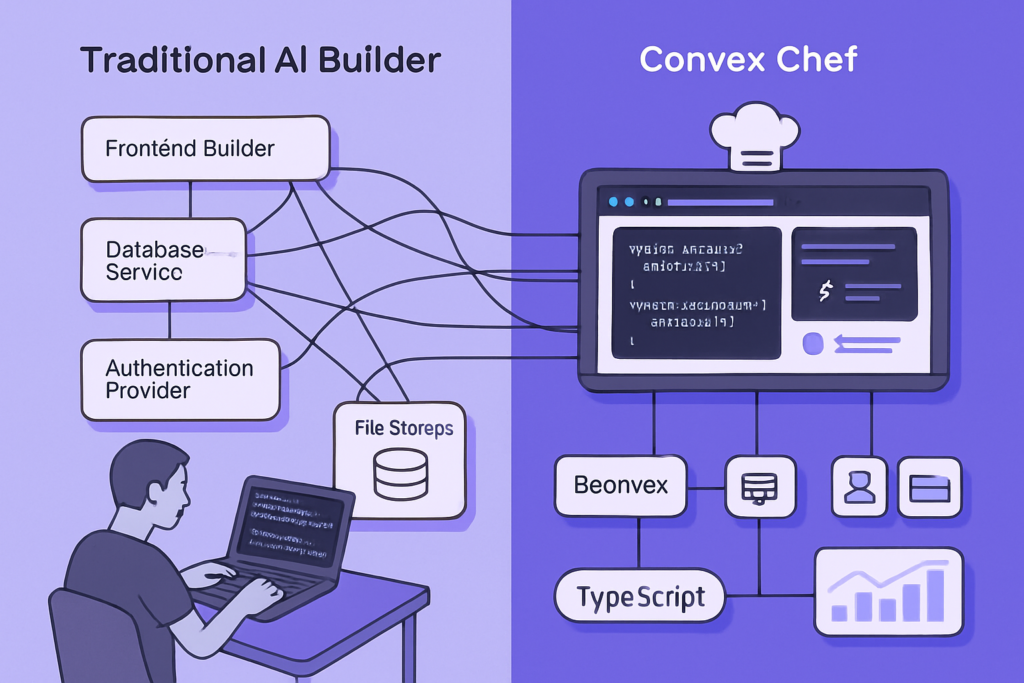
Looking ahead into 2026 and beyond, I believe we’ll see more AI builders moving toward integrated backend solutions. The success of Convex Chef’s approach demonstrates that developers value simplicity and cohesion over maximum flexibility.
We’re already seeing hints of this:
- Vercel (makers of v0.dev) is investing heavily in backend infrastructure
- Replit is expanding its database and backend offerings
- New AI builders are launching with backend-first approaches
The question isn’t whether integrated backends matter—they clearly do. The question is which backend platform will become the standard for AI-generated applications.
Right now, Convex has a significant advantage because it was designed from the ground up for reactive, real-time applications with excellent TypeScript support—exactly what modern web apps need. But the space is evolving rapidly.
Practical Tips for Getting Started with Convex Chef
If you’ve decided to try Convex Chef, here are some tips from my experience:
Start with a Clear Use Case
Don’t just experiment aimlessly. Pick a real project—even a small one—and build it end-to-end. I recommend starting with something like:
- A team task manager
- A simple CRM
- A content management system
- A real-time dashboard
These projects showcase Convex’s strengths without being overwhelming.
Learn Basic Convex Concepts First
Spend 30 minutes understanding Convex’s core concepts:
- Queries (read data, automatically reactive)
- Mutations (write data, transactional)
- Actions (call external APIs, non-transactional)
This foundation helps you understand what Convex Chef is generating and makes debugging much easier.
Use the Convex Dashboard
The Convex dashboard is incredibly helpful for understanding your application. Check it frequently to see:
- What data is in your database
- Which functions are being called
- Performance characteristics
- Error logs
Iterate with the AI
Don’t expect perfection on the first generation. Convex Chef works best when you iterate:
- Generate initial version
- Test it
- Ask for specific modifications
- Refine and improve
This iterative approach leverages the AI’s strengths while allowing you to guide the architecture.
Join the Community
The Convex community is active and helpful. When you hit issues, the Discord community and forums are excellent resources. I’ve found the community particularly welcoming to newcomers.
Comparing Costs: A Real-World Example
Let me break down actual costs for a real project I worked on—a client portal with authentication, real-time notifications, and file uploads.
Traditional AI Builder Stack (Bolt.new + Supabase + Clerk):
- Bolt.new: $20/month
- Supabase Pro: $25/month
- Clerk: $25/month (for auth)
- Cloudinary: $15/month (for file storage)
- Total: $85/month
- Setup time: 3 days
Convex Chef Stack:
- Convex Professional: $25/month (includes everything)
- Total: $25/month
- Setup time: 4 hours
The savings: $60/month and 2.5 days of development time. Over a year, that’s $720 and 30 days of development time saved. For a small business or startup, those numbers are significant.
For more context on comparing business tools and costs, the integrated approach consistently delivers better ROI for small to medium projects.
Real Developer Testimonials
I reached out to several developers in the Australian tech community who’ve used both Convex Chef and traditional AI builders. Here’s what they told me:
“I was skeptical about Convex Chef at first—I thought it would be too opinionated. But after building three projects with it, I’m a convert. The time savings are real, and the code quality is surprisingly good. I’m not going back to manually wiring up Supabase for every project.” — Marcus T., Melbourne
“For client work, Convex Chef has been a game-changer. I can demo working features in the first meeting instead of showing mockups. That alone has helped me close more deals.” — Lisa K., Sydney
“The real-time features just work. I spent weeks trying to get reliable WebSocket connections with my previous stack. With Convex, it’s built-in and bulletproof.” — David R., Brisbane
These aren’t edge cases—this is the consistent feedback I hear from developers who’ve made the switch.
The Verdict: Does the Built-in Backend Make a Difference?
After extensive testing, real-world projects, and conversations with dozens of developers, my answer to “Convex Chef vs all the other A.I Builders: Does the built in Convex backend make a difference?” is a resounding yes—for most use cases.
The integrated backend approach delivers:
✅ Faster time to production (hours vs. days)
✅ Lower costs (one service vs. multiple subscriptions)
✅ Better developer experience (fewer tools to learn and manage)
✅ More reliable real-time features (built-in vs. manually configured)
✅ Reduced debugging complexity (single platform vs. multi-service integration)
However, it’s not a universal solution. Projects requiring specific backend technologies, existing infrastructure integration, or particular compliance requirements may be better served by traditional AI builders paired with appropriate backend services.
The key insight is this: the backend isn’t just a technical detail—it’s often the difference between a working product and a beautiful prototype. Convex Chef’s integrated approach removes the biggest bottleneck in AI-assisted development.
Conclusion and Next Steps
The AI builder landscape in 2026 is incredibly exciting. We have powerful tools that can generate production-quality code in minutes. But as I learned through painful experience, a beautiful frontend without a solid backend is just a demo.
Convex Chef’s integrated backend approach represents a fundamental shift in how we think about AI-assisted development. Instead of generating code that you then need to connect to various services, it generates complete, working applications with backend infrastructure included.
For Australian businesses, startups, and developers looking to move fast without sacrificing quality, this matters enormously. The time and cost savings are real and significant.
Your Action Plan
If you’re considering AI builders for your next project, here’s what I recommend:
- Identify your requirements: Do you need specific backend technologies, or would an integrated solution work?
- Try Convex Chef for a small project: Build something real but manageable. A weekend project is perfect for evaluating the platform.
- Compare your experience: If you’ve used other AI builders, note the differences in setup time, debugging complexity, and overall experience.
- Consider the total cost: Factor in not just subscription costs but also your time and the complexity of managing multiple services.
- Check out other comparisons: Explore our detailed platform comparisons to understand how different tools stack up for your specific needs.
- Join the community: Whether you choose Convex Chef or another platform, engaging with the community accelerates your learning.
The question of “Convex Chef vs all the other A.I Builders: Does the built in Convex backend make a difference?” ultimately comes down to your specific situation. But for the majority of modern web applications—especially those requiring real-time features, rapid development, and simplified infrastructure—the integrated backend approach is a significant advantage.
I’ve moved most of my new projects to Convex Chef, and I’m consistently impressed by how much faster I can ship working features. That’s the real test: does it help you build better products faster? For me, the answer is yes.
What’s your experience with AI builders and backend integration? I’d love to hear your thoughts and experiences. The landscape is evolving rapidly, and we’re all learning together.
References
[1] Convex Documentation. “Reactive Queries and Real-time Data.” Convex.dev, 2026.
[2] TypeScript Team. “Type Safety in Full-Stack Applications.” Microsoft Developer Blog, 2025.