
Last summer, my neighbor Sarah knocked on my door at 7 AM, eyes red and watery, asking if I’d noticed the “weird smell” outside. We stepped onto the porch together, and there it was—a hazy orange sky that looked like something out of a dystopian film. Bushfire smoke had rolled into our Sydney suburb overnight, and by midday, the air quality index had skyrocketed to hazardous levels. That’s when Sarah told me she was finally buying an air purifier, something she’d been putting off for months. Her story isn’t unique. Across Australia in 2026, millions of households are making the same decision, driven by bushfire seasons, rising asthma rates, and a growing awareness of indoor air quality. If you’re reading this Air Purifier Choices In Australia: 2026 Full Review, you’re probably in the same boat—ready to breathe cleaner air but overwhelmed by the sheer number of options available.
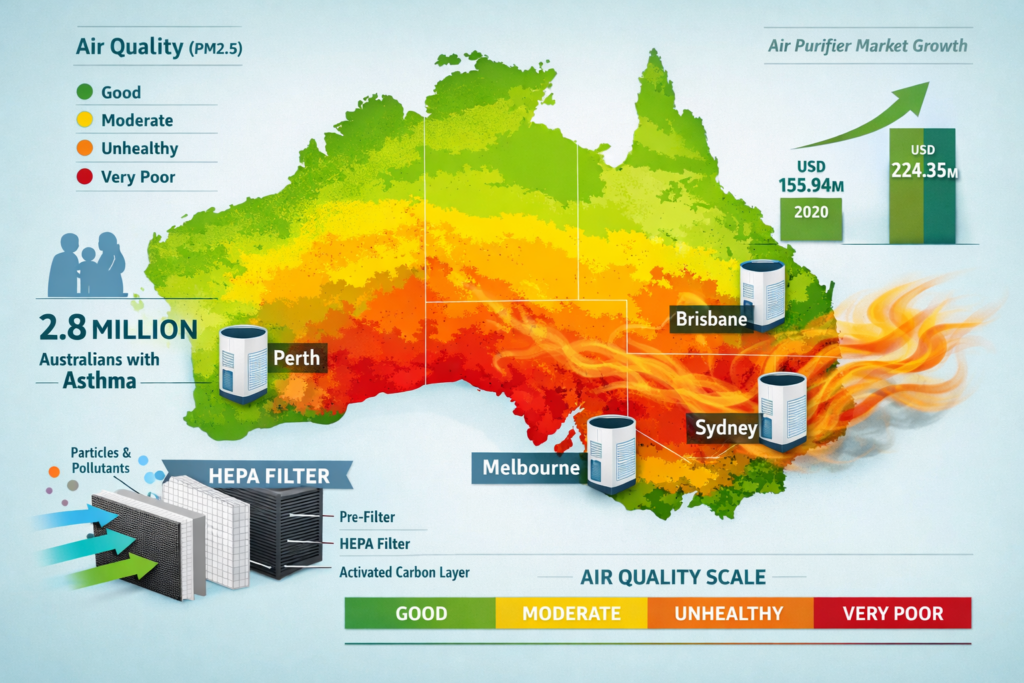
The Australian air purifier market has exploded, growing from USD 155.94 million in 2024 to a projected USD 224.35 million by 2030[1]. With approximately 2.8 million Australians living with long-term asthma[2], and tightening national air quality standards, choosing the right air purifier isn’t just about comfort—it’s about health, safety, and peace of mind.
Key Takeaways
✅ Market Growth: Australia’s air purifier market is expanding at 6.25% annually, reaching USD 224.35 million by 2030, driven by health awareness and environmental concerns.
✅ HEPA + Activated Carbon: The most effective combination captures 99.97% of particles down to 0.3 microns while eliminating odors, gases, and VOCs.
✅ Smart Features Matter: Wi-Fi connectivity, app control, and real-time air quality monitoring are becoming standard expectations in 2026.
✅ Regional Considerations: Sydney and Canberra lead adoption due to traffic emissions, construction dust, and bushfire exposure—but every Australian region faces unique air quality challenges.
✅ Energy Efficiency: Look for ENERGY STAR certified models with smart sensors to reduce electricity costs and environmental impact.
Understanding Australia’s Air Quality Crisis in 2026
I’ll never forget the “Black Summer” fires of 2019-2020. I was living in Melbourne at the time, and for weeks, we couldn’t open our windows. The air inside our apartment felt stale and suffocating, but opening a window meant inviting in smoke so thick you could taste it. That experience changed how Australians think about air quality forever.
Why Air Purifiers Have Become Essential
Bushfire smoke remains the most significant driver of air purifier adoption across Australia. Climate patterns in 2026 continue to create extended fire seasons, particularly affecting New South Wales, Victoria, and parts of Queensland. But bushfires are just one piece of the puzzle.
Urban pollution in major cities like Sydney, Melbourne, and Brisbane contributes daily to poor indoor air quality. Traffic emissions, construction dust, and industrial activities create a constant barrage of particulate matter that seeps into our homes and workplaces.
The National Environment Protection (Ambient Air Quality) Measure has tightened PM₂.₅ standards to an annual average of 7 µg/m³ and a 24-hour average of 20 µg/m³[3]. These stricter regulations reflect growing scientific evidence about the health impacts of fine particulate matter.
The Health Impact: More Than Just Allergies
With 11% of Australians (approximately 2.8 million people) living with long-term asthma[2], respiratory health has become a national priority. But the concerns extend beyond asthma:
- Allergies: Pollen, dust mites, and pet dander trigger reactions year-round
- Volatile Organic Compounds (VOCs): Off-gassing from furniture, paint, and cleaning products
- Mold spores: Particularly problematic in humid coastal regions
- Viruses and bacteria: Heightened awareness post-pandemic
- Odors: Cooking smells, smoke, and pet odors affect quality of life
My friend David, who lives in Canberra, installed an air purifier after his daughter’s asthma attacks became more frequent. Within two weeks, he noticed a dramatic reduction in her nighttime coughing. “I wish we’d done this years ago,” he told me over coffee. “The difference is night and day.”
Key Features to Look for in Air Purifier Choices In Australia: 2026 Full Review
When I started researching air purifiers for my own home, I was overwhelmed by technical jargon. CADR ratings? ACH numbers? True HEPA versus HEPA-type? Let me break down what actually matters.
Filter Technology: The Heart of Any Air Purifier
HEPA Filters (High-Efficiency Particulate Air) are the gold standard. True HEPA filters capture 99.97% of particles as small as 0.3 microns[4]. This includes:
- Dust and dust mites
- Pollen
- Pet dander
- Mold spores
- Some bacteria and viruses
Activated Carbon Filters work alongside HEPA filters to absorb:
- Odors (cooking, pets, smoke)
- Gases
- Volatile Organic Compounds (VOCs)
- Chemical fumes
The combination of HEPA + Activated Carbon dominates the Australian market for good reason—it addresses both particulate matter and gaseous pollutants.
“The best air purifier is one that combines multiple filtration technologies to address the full spectrum of indoor air pollutants.” — Australian Asthma Council
Smart Features: Welcome to 2026
Smart and connected air purifiers are experiencing rapid adoption across Australia. Here’s what modern units offer:
🔌 Wi-Fi Connectivity: Control your purifier from anywhere using smartphone apps
🗣️ Voice Control: Integration with Amazon Alexa and Google Assistant
📊 Real-Time Monitoring: Live air quality data displayed on your device
⚙️ Auto Mode: Sensors detect pollution levels and adjust fan speed automatically
📅 Filter Life Tracking: Notifications when it’s time to replace filters
⏰ Scheduling: Set operating times to match your routine
I recently upgraded to a smart air purifier, and honestly, the convenience factor is incredible. I can turn it on high before I get home from work, and the app shows me exactly how the air quality improves over time. It’s like having a personal air quality assistant.
Room Size and CADR Ratings
CADR (Clean Air Delivery Rate) measures how quickly an air purifier can clean the air in a specific room size. Higher CADR numbers mean faster air cleaning.
Here’s a simple guide:
| Room Size | Minimum CADR | Recommended CADR |
|---|---|---|
| Small (up to 20m²) | 100-150 | 150-200 |
| Medium (20-40m²) | 200-300 | 300-400 |
| Large (40-60m²) | 400-500 | 500-650 |
| Extra Large (60m²+) | 650+ | 800+ |
Air Changes Per Hour (ACH) indicates how many times the purifier can filter the entire room’s air volume in one hour. For allergy and asthma sufferers, aim for at least 4-5 ACH.
Energy Efficiency: Running Costs Matter
Energy-efficient air purifiers with low-power motors and smart sensors are gaining significant traction in 2026. Australians are increasingly conscious of electricity costs and environmental impact.
Look for:
- ENERGY STAR certification
- DC motors (more efficient than AC motors)
- Smart sensors that adjust operation based on air quality
- Sleep modes with reduced power consumption
A typical air purifier runs 8-24 hours daily. An inefficient model consuming 100W costs approximately $130-$390 annually in electricity, while an efficient 30W model costs only $39-$117[5]. Over the unit’s lifespan, this adds up significantly.
Top Air Purifier Categories for Australian Homes
Portable and Compact Models
Urban apartment living dominates Australian cities, driving demand for portable and compact air purifiers. These units typically:
- Cover 15-30m² (perfect for bedrooms or home offices)
- Weigh under 5kg for easy movement
- Feature sleek, modern designs that complement décor
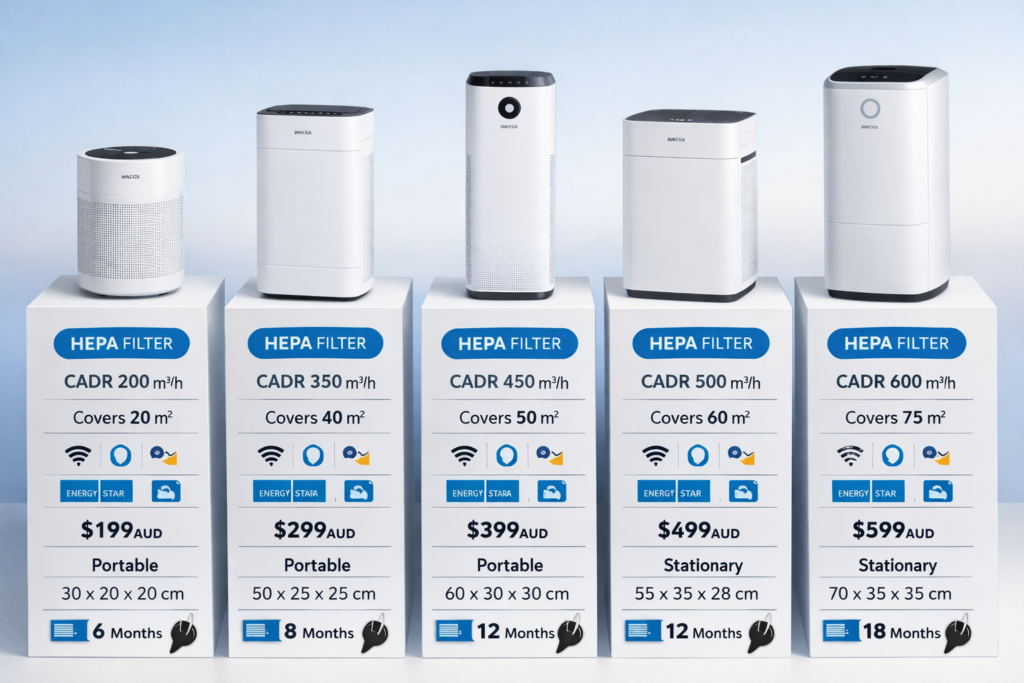
- Cost between $150-$400 AUD
My sister lives in a small apartment in Melbourne’s CBD, and she swears by her compact air purifier. “I move it between my bedroom at night and the living area during the day,” she explains. “It’s like having two purifiers for the price of one.”
Whole-Home Systems
For larger homes or families serious about air quality, whole-home air purifiers integrate with HVAC systems or operate as standalone high-capacity units:
- Cover 60-150m² or entire homes
- Higher initial investment ($800-$2,500 AUD)
- Lower per-room cost compared to multiple small units
- Professional installation often recommended
Car Air Purifiers
An emerging segment in the Air Purifier Choices In Australia: 2026 Full Review landscape is car air purifiers. With Australians spending an average of 4.5 hours weekly commuting[6], these compact units address:
- Traffic exhaust fumes
- Dust and pollen entering through ventilation
- Odors from upholstery and air conditioning
- Bacteria and viruses in enclosed spaces
Car purifiers typically plug into 12V outlets and range from $50-$200 AUD.
Commercial-Grade Units
Businesses, schools, and healthcare facilities increasingly invest in commercial-grade air purifiers that offer:
- Coverage for 100-300m² spaces
- Higher CADR ratings (800-1,200+)
- Durable construction for 24/7 operation
- Advanced filtration including UV-C sterilization
Regional Considerations: Air Purifier Choices In Australia By Location
Australia’s vast geography means air quality challenges vary dramatically by region. Let me break down what matters where you live.
New South Wales and Australian Capital Territory
Sydney and Canberra represent the largest markets for air purifiers in Australia[1]. Key concerns include:
- Traffic emissions: Heavy vehicle congestion in Sydney
- Construction dust: Ongoing urban development
- Bushfire smoke: Regular exposure during fire season
- Pollen: High levels spring through early summer
Recommendation: Medium to large HEPA + Activated Carbon units with smart sensors to detect rapid air quality changes during bushfire events.
Victoria
Melbourne faces unique challenges:
- Urban pollution: Second-largest city with significant traffic
- Seasonal allergies: Notorious for “thunderstorm asthma” events
- Bushfire exposure: Particularly in outer suburbs
- Mold: Higher humidity in coastal areas
Recommendation: Units with strong allergen filtration and humidity monitoring capabilities.
Queensland
Brisbane and coastal areas deal with:
- High humidity: Encouraging mold and mildew growth
- Tropical allergens: Year-round pollen and spores
- Bushfire smoke: Northern regions during dry season
- VOCs: Off-gassing accelerated by heat
Recommendation: Air purifiers with dehumidification features or paired with separate dehumidifiers, plus strong carbon filtration for VOCs.
Western Australia
Perth experiences:
- Dust storms: Particularly spring and summer
- Bushfire smoke: From regional fires
- Pollen: Native flora produces unique allergens
- Isolation: Limited retail options favor online shopping
Recommendation: High-capacity particle filtration with easy online filter replacement options.
South Australia and Tasmania
Adelaide and Hobart have:
- Seasonal bushfire exposure: Particularly Adelaide Hills and Tasmanian wilderness areas
- Industrial emissions: Port and manufacturing areas
- Lower overall pollution: But still benefit from filtration
- Colder climates: Homes sealed tighter, trapping pollutants
Recommendation: Balanced HEPA + Carbon systems with energy-efficient operation for extended use.
Sustainability and Environmental Considerations
As someone who tries to make environmentally conscious choices, I was initially concerned about the waste generated by air purifier filters. Thankfully, the industry is responding to sustainability trends.
Eco-Friendly Features in 2026
Manufacturers are developing:
- Recyclable filters: Programs to return used filters for proper recycling
- Biodegradable materials: Plant-based filter components
- Longer-lasting filters: 12-18 month lifespans versus 6 months
- Washable pre-filters: Reducing disposable filter frequency
- ENERGY STAR certification: Minimizing electricity consumption
- Low-carbon manufacturing: Reduced emissions in production
Tip: Look for brands offering filter recycling programs. Some Australian retailers now provide mail-back services where used filters are properly processed rather than ending up in landfills.
Total Cost of Ownership
When evaluating air purifiers, consider the complete picture:
Initial Purchase Price: $150-$2,500 AUD depending on size and features
Replacement Filters: $50-$200 annually (varies by usage and model)
Electricity Costs: $40-$150 annually (depending on efficiency and usage)
Maintenance: Minimal—occasional cleaning of exterior and pre-filters
Over a typical 5-year lifespan, a $400 purifier might cost $1,150 total, while a cheaper $200 unit with expensive filters and high power consumption might cost $1,400. Do the math before buying.
Online Shopping vs. Retail Stores
Online retailers represent the fastest-growing distribution channel for air purifiers in Australia[1]. Having purchased units both ways, I can share insights on each approach.
Advantages of Online Shopping
✅ Wider selection: Access to international brands not stocked locally
✅ Competitive pricing: Often 15-30% cheaper than retail
✅ Convenient delivery: Doorstep delivery, especially valuable for heavy units
✅ Customer reviews: Read real experiences before purchasing
✅ Easy comparison: Compare specifications and prices across multiple brands
✅ Sales and promotions: Frequent discounts and bundle deals
Advantages of Retail Stores
✅ Physical inspection: See size, build quality, and design in person
✅ Immediate availability: Take it home today
✅ Expert advice: Speak with knowledgeable staff (quality varies)
✅ Easy returns: Simpler return process for local stores
✅ Support local business: Contribute to local economy
My recommendation: Research extensively online, then check if local retailers can price-match. If the price difference is significant (over $100), online shopping makes sense. For smaller differences, supporting local retail has value.
Making Your Choice: A Practical Framework
After reviewing countless models and talking to dozens of Australian households, I’ve developed a simple framework for choosing the right air purifier.
Step 1: Identify Your Primary Concern
What’s driving your purchase?
- Allergies/Asthma: Prioritize True HEPA filtration and high ACH
- Bushfire smoke: Look for high CADR and activated carbon
- Pet odors: Strong activated carbon filtration essential
- VOCs/Chemical sensitivity: Medical-grade carbon filters
- General air quality: Balanced HEPA + Carbon combination
Step 2: Measure Your Space
Accurately measure the room(s) where you’ll use the purifier. Remember:
- Open-plan areas require higher CADR ratings
- Multiple rooms need multiple units or a whole-home system
- Ceiling height matters—high ceilings increase room volume
Step 3: Set Your Budget
Be realistic about total cost:
- Budget: $150-$350 (suitable for small rooms, basic features)
- Mid-range: $350-$800 (medium rooms, smart features, better efficiency)
- Premium: $800-$1,500 (large coverage, advanced features, top efficiency)
- Whole-home: $1,500-$2,500+ (comprehensive coverage, professional-grade)
Step 4: Prioritize Features
Rank these features by importance to you:
- Smart connectivity and app control
- Noise level (especially for bedrooms)
- Energy efficiency
- Filter replacement cost and availability
- Design and aesthetics
- Brand reputation and warranty
- Air quality sensors and display
Step 5: Research and Compare
Use the survey tool below to help narrow your options, then:
- Read customer reviews on multiple platforms
- Check independent testing results
- Verify Australian electrical compliance
- Confirm filter availability in Australia
- Review warranty terms and customer service reputation
🌬️ Find Your Perfect Air Purifier
Answer a few questions to get personalized recommendations for your Australian home
Your Personalized Recommendations
Common Mistakes to Avoid When Buying Air Purifiers
I’ve made some of these mistakes myself, and I’ve watched friends make others. Learn from our experiences:
❌ Buying Based on Price Alone
The cheapest unit often has the highest total cost of ownership. Expensive replacement filters and high electricity consumption add up quickly.
❌ Undersizing Your Purifier
A purifier rated for 20m² won’t effectively clean a 40m² room, no matter how long you run it. Always size up if you’re between categories.
❌ Ignoring Filter Replacement Costs
Some brands charge $150+ for replacement filters that need changing every 6 months. That’s $300 annually—more than some entire units cost!
❌ Falling for “HEPA-Type” or “HEPA-Like” Claims
Only True HEPA filters meet the 99.97% efficiency standard. “HEPA-type” is marketing language for inferior filters.
❌ Neglecting Noise Levels
A purifier that sounds like a jet engine won’t get used, especially in bedrooms. Check decibel ratings before buying.
❌ Overlooking Smart Features You’ll Actually Use
Smart features add cost. If you won’t use app control or voice commands, don’t pay extra for them. Conversely, if you love smart home tech, these features significantly enhance the experience.
❌ Forgetting About Maintenance
Air purifiers need regular filter changes and occasional cleaning. If you’re not committed to maintenance, the unit’s effectiveness drops dramatically.
The Future of Air Purification in Australia
Looking ahead, several trends are shaping the Air Purifier Choices In Australia: 2026 Full Review landscape:
Advanced Sensor Technology
Next-generation purifiers will detect specific pollutants—not just general particle counts. Imagine a unit that identifies when bushfire smoke enters your home versus normal dust, adjusting filtration accordingly.
Integration with Smart Home Ecosystems
Deeper integration with home automation systems will allow purifiers to communicate with HVAC systems, windows, and even weather forecasts. Your purifier might automatically increase speed when bushfire smoke is detected in your suburb.
Sustainable Innovation
Expect to see:
- Biodegradable filters made from plant materials
- Solar-powered units for off-grid homes
- Filter subscription services with automatic recycling
- Longer-lasting filters (18-24 months)
- Modular designs for easy repair versus replacement
Medical-Grade Home Units
As health awareness grows, medical-grade filtration (previously only in hospitals) is becoming available for residential use, offering UV-C sterilization, ionization, and multi-stage filtration.
Personalized Air Quality
Future units may tailor filtration to individual health needs, adjusting settings based on asthma triggers, specific allergies, or respiratory conditions tracked through health apps.
Real Stories: How Air Purifiers Changed Lives
Let me share a few stories from people I know whose lives genuinely improved after investing in air purifiers.
Emma’s Story (Brisbane): Emma’s 6-year-old son Marcus had severe asthma triggered by dust mites and mold spores. They were in the emergency room three times in 2024. After installing air purifiers in his bedroom and the main living area, his attacks decreased by 80%. “We haven’t been to emergency once this year,” Emma told me with tears in her eyes. “It’s given us our life back.”
James’s Story (Sydney): James works from home in a small apartment near a busy road. He struggled with headaches and fatigue, which he attributed to stress. After installing an air purifier with VOC detection, he discovered his indoor air quality was consistently poor due to traffic fumes. Within two weeks of running the purifier, his headaches disappeared. “I didn’t realize how much the air quality was affecting me until it improved,” he said.
Linda’s Story (Melbourne): Linda is a retired teacher with three cats. She loved her pets but was embarrassed by the persistent odor in her home. A friend suggested an air purifier with strong activated carbon filtration. “The difference was immediate,” she recalls. “Within 24 hours, the smell was gone. Now I can have guests over without worrying.”
These stories remind me why air purifiers matter—they’re not just appliances; they’re investments in health and quality of life.
Frequently Asked Questions
How often should I replace filters?
HEPA filters typically last 12-18 months with normal use, while activated carbon filters last 6-12 months. Pre-filters should be cleaned monthly and replaced every 3-6 months. Always follow manufacturer recommendations and check filter indicators if your unit has them.
Can I run my air purifier 24/7?
Yes! Most modern air purifiers are designed for continuous operation. In fact, running them constantly is more effective than intermittent use. Use auto-mode or lower speeds when air quality is good to save energy.
Do air purifiers help with COVID-19 and other viruses?
True HEPA filters can capture virus particles (which are often attached to larger droplets or aerosols). While not a replacement for vaccination or other precautions, air purifiers add an extra layer of protection, especially in shared indoor spaces[7].
How loud are air purifiers?
It varies significantly. On low settings, quality units operate at 25-35dB (whisper-quiet). On high settings, expect 50-65dB (conversational level). Check specifications before buying if noise is a concern.
Can I use an air purifier with windows open?
You can, but it’s less efficient. Open windows introduce new pollutants faster than the purifier can clean them. For best results, run purifiers in closed rooms, opening windows periodically for fresh air when outdoor air quality is good.
Are ionizers and ozone generators safe?
Ionizers are generally safe when properly designed, but ozone generators can produce harmful ozone levels and should be avoided in occupied spaces[8]. Stick with HEPA and carbon filtration for safety.
Taking Action: Your Air Purifier Journey Starts Now
If you’ve read this far, you’re serious about improving your indoor air quality. That’s fantastic! Here’s your action plan:
This Week
- Measure your spaces: Get accurate room dimensions
- Identify your primary concern: Allergies, smoke, pets, VOCs, or general quality
- Set your budget: Remember to include filter costs
- Use the survey tool above to narrow your options
Next Week
- Research 3-5 specific models that match your criteria
- Read Australian customer reviews on ProductReview.com.au and Choice.com.au
- Calculate total 5-year ownership costs for your top choices
- Check filter availability in Australia for your shortlisted models
Within Two Weeks
- Make your purchase (online or retail)
- Set up properly: Position away from walls, at least 30cm clearance
- Run on high for the first 24 hours to establish baseline air quality
- Create a maintenance schedule: Filter checks, cleaning reminders
Ongoing
- Monitor air quality using your purifier’s sensors or separate AQI monitor
- Replace filters on schedule—don’t wait for performance to drop
- Clean pre-filters monthly to extend main filter life
- Adjust settings seasonally: Higher during bushfire season, lower in winter
Conclusion
The Air Purifier Choices In Australia: 2026 Full Review landscape is more diverse and sophisticated than ever before. With the market growing from USD 155.94 million in 2024 to a projected USD 224.35 million by 2030, Australians are voting with their wallets—clean air matters.
Whether you’re one of the 2.8 million Australians living with asthma, a parent concerned about your children’s respiratory health, or simply someone who wants to breathe easier in your own home, there’s an air purifier solution that fits your needs and budget.
Remember my neighbor Sarah from the beginning of this article? She bought a mid-range air purifier with HEPA and activated carbon filtration. During the last bushfire smoke event, while others in our neighborhood were stuck indoors with windows sealed and stale air, Sarah’s home maintained healthy air quality. She told me she felt empowered—like she’d taken control of at least one aspect of the environmental challenges we face.
That’s what the right air purifier does. It gives you control. It protects your health. It improves your quality of life.
The air you breathe in your home should be clean, fresh, and healthy. With the information in this comprehensive review, you’re now equipped to make an informed decision that will benefit you and your family for years to come.
Take that first step today. Your lungs will thank you. 🌬️💚
References
[1] Australia Air Purifiers Market Analysis, 2024-2030, Industry Research Reports
[2] Australian Institute of Health and Welfare, Asthma Statistics 2024
[3] National Environment Protection (Ambient Air Quality) Measure, Australian Government Department of Climate Change, Energy, the Environment and Water, 2025
[4] United States Environmental Protection Agency, “What is a HEPA filter?”, Indoor Air Quality Guidelines
[5] Energy cost calculations based on average Australian electricity rates of $0.30/kWh, 2026
[6] Australian Bureau of Statistics, Commuting Patterns and Transport Usage, 2024
[7] Centers for Disease Control and Prevention, “Ventilation in Buildings: Air Filtration”, 2023
[8] Australian Competition and Consumer Commission, Product Safety Guidelines for Air Treatment Devices, 2024